Learning about heritage
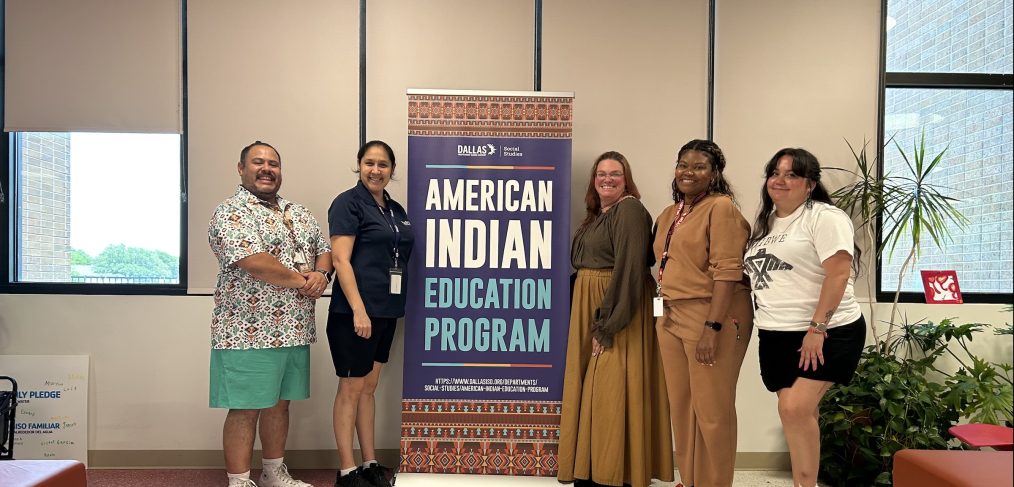
At the American Indian Education Program Cultural Camp, which took place in June, morning started with a simple sentence that carries centuries behind it.
Antonio Jose Cisneros, who teaches at the School for the Talented and Gifted in Pleasant Grove, looked out at a semicircle of children, some still eating their breakfasts, and told them the camp’s central message, “We are still here.”
To Cisneros, this is not a slogan but a living truth, something he hoped would settle into the kids’ bones the way stories do when told by a grandparent at dusk.
Many of the campers were just beginning to ask questions. For Cisneros, that starting point is sacred.
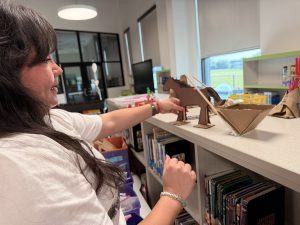 “A lot of people think Native Americans only exist in history books,” Cisneros said. “We want these kids to know their cultures, their roots, their stories are alive right now.”
This year the camp focused on Native nations in Texas, including the Caddo and Comanche Nations. Each morning Cisneros pointed to an “essential question” written on the board. From there, the group studied when these nations settled on the land, how they built homes, how they found food, and how they related to the natural world.
“We don’t want them to think of Native people as something from the past,” Cisneros said. “We want them to understand a living culture, not just a date in a book.”
To do that, the camp uses materials written and produced by Native communities.
“We are telling our own stories,” Cisneros added. “We don’t hide the hard parts, but we make sure students are ready to hear them.”
Those hard parts come into focus during story time. One morning, Cisneros told the campers to imagine someone arriving at their door.
“What if a person came tomorrow, cut your hair, took your name, and told you, ‘You can’t speak Spanish anymore. You can only speak English?’” he asked. The room goes quiet. Then the students begin to talk about boarding schools, language loss, and what it means to have your identity taken from you.

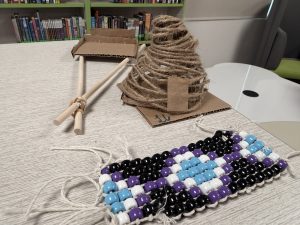 In the afternoons, the learning moves outside and onto tables covered with paper, sticks, and art supplies. Children weave small baskets, build model tepees, and design maps of imagined villages. On one map, a girl places her village on the far side of a river.
“‘The river can be our border,’ I remember the student saying,” Cisneros said. “She told me we don’t have to fight if we have space.”
Ashley Armstrong, who teaches Spanish at Sunset High School and co-taught the Native Cultural Camp, watched those moments closely. She noticed when an older camper bent down to show a younger one how to tie a knot or paint a symbol.
“They love teaching each other,” Armstrong said. “You see a kid who was quiet on Monday suddenly explaining their tribe’s traditions by Thursday.”
Armstrong measured success in these small shifts.
“One of my students looked up from a book during story time and said, ‘We’re still here,’” she recalled. “She wasn’t asking a question. She was claiming it.”
Both Cisneros and Armstrong used pre‑ and post‑assessments, journals full of drawings, and portfolios of projects to track growth. Parents saw the numbers. What they feel, though, is something else: a child who wants to talk about ancestors, who holds their culture with a little more certainty. As the week drew to a close, Cisneros summed up what he hopes the students will carry forward.
“History tried to erase us,” he said. “But every time a child says, ‘I know who I am,’ that history loses.”