
Debate leads to student and teacher success
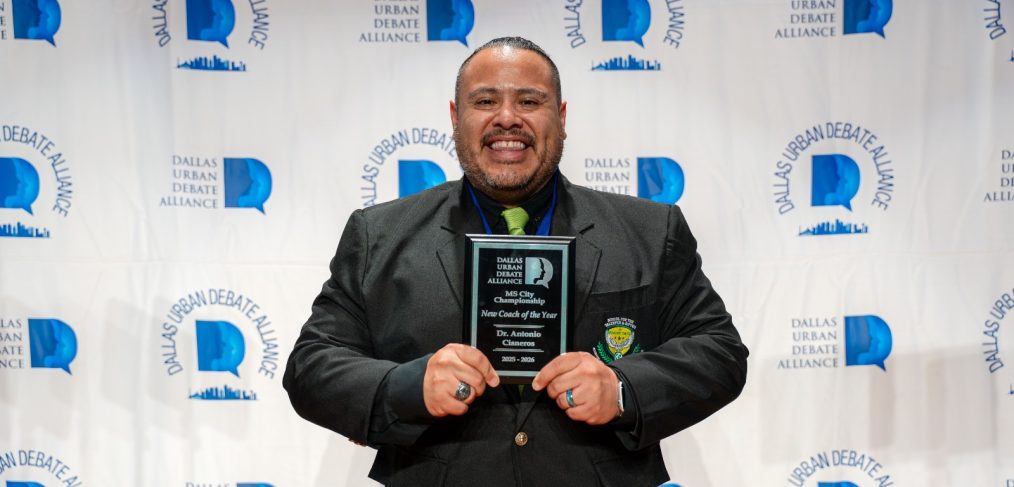
When Antonio Jose Cisneros Tirado, fifth-grade mathematics and English language arts teacher at the School for the Talented and Gifted in Pleasant Grove first agreed to start a debate program, he didn’t picture himself walking away with the Middle School City Championship New Coach of the Year Award from Dallas Urban Debate Alliance in his very first season. He just wanted to give his students something he never had.
Cisneros grew up in Mexico City, in what he simply describes as “el barrio.” He was a talented, high-achieving kid, but public options for gifted education were almost nonexistent. He remembers looking around and hoping there would be a better option for kids like him.
“I was never going to be able to attend a private talented and gifted school,” Cisneros said. “So I just kept asking myself, there has to be a place where we can build the right type of environment for talented and gifted learners to really expand on their potential.”
Years later, after earning a degree from the Universidad de las Américas Puebla; a master’s and doctorate from University of East Anglia in Norwich, England; a tenured post at Benémerita Universidad Autónoma de Puebla; and completing a stint as a distinguished visiting professor at Appalachian State University in North Carolina, that “place” unexpectedly turned out to be Pleasant Grove in Dallas.
When Cisneros came to Dallas ISD, he made his way to STAG, a school he described as “a small campus with big ambitions.” The school, which opened in 2018, quickly rose to become a top-seven middle school and top-12 elementary school in Texas while serving a student body that is about 98% economically disadvantaged and overwhelmingly Latino.
“Zip code doesn’t mean destiny” became something like a personal motto, Cisneros said.
So when Principal Reymundo Cervantes Guajardo asked if he’d be willing to start a debate program, Cisneros jumped in, even though he had never coached debate.
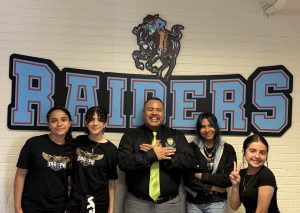 He received training and mentorship from Evan Gilbert of the Dallas Urban Debate Alliance, learned the mechanics, and then started experimenting. He recruited students, looking for three things: analysis, argument writing, and delivery.
“Students had to learn to be analytical,” Cisneros said. “They needed to be able to break a problem apart, create a story, and then deliver it in a way that connects with the judges.”
The early days weren’t glamorous. Practices were just one hour a week after school on Thursdays. No designated class period built into the schedule, no daily coaching blocks—just tired middle schoolers and a teacher trying to squeeze as much growth as possible into 60 minutes, he said.
“Self-confidence was only built through practice and repetition,” Cisneros said. “But I only get them one hour per week, so I had to be super strategic.”
Between practices, his students had to read all the prepared materials, write their own note cards, and come ready with arguments. During practice, they drilled the basics: reading and speaking with confidence, cross-examinations, rebuttals, and “flowing,” which is taking notes on opponents’ speeches in real time.
Cisneros said the students delivered results in spades.
From their very first tournament, the Pleasant Grove team made noise. Competing in the beginners policy category, they swept the podium—first, second, and third place. Throughout the season, they kept placing in the top 10. In one memorable tournament, one STAG student had to debate alone, facing full teams of two and still finishing second overall.
“This student’s grades needed improvement,” Cisneros said. “I told him, ‘You need to get your grades up, otherwise you’re not going to be able to participate.’ He went on to get nothing but As.”
The topic they debated all year wasn’t an easy one. Students argued whether the United States should establish maritime protected areas in the Arctic—an issue tangled with climate change, conservation, indigenous rights, and global power struggles with Russia and China.
“It was an extremely complex topic,” Cisneros said. “But I used my background in politics to break the big ideas into more manageable bullets and concepts.”
Underneath the trophies and the technical skills, though, Cisneros kept coming back to something deeper. He wanted his students to be tough and kind at the same time.
“I’m trying to teach them to be fierce but fair,” Cisneros said. “Life requires us to be strong fighters, but also compassionate people who can empathize with other positions while still defending our own.”
In his classroom and in the debate club, relationships came first. Cisneros showed up on time, with snacks on the table and materials ready. Students trusted him enough to talk about family drama, friends, and everything in between. He has been invited to their quinceañeras and proms and met parents and cousins and tías.
“I like to think they come in as students and leave as lifelong friends,” Cisneros said. “I want them to remember me as somebody they could trust, somebody who helped them walk taller, speak better, and believe in themselves.”
Looking ahead, Cisneros didn’t see this year as a peak; he saw it as a starting point. He plans to grow the program, refine his selection process, and take his team to higher levels of competition—hopefully nationals.
He also had one more encouraging message for his students, who might sometimes feel limited by the circumstances in their lives.
“You are not the end of your family story,” Cisneros said. “You are the most powerful chapter yet.”