Helping students navigate a visual world
Britney Cooks, a mobility therapist in the Vision Program Department, steps into work every day with a clear sense of mission: open doors, expand worlds, and prove that blindness does not limit a child’s potential.
Cooks works in a department that serves a small population but makes a big difference. Across Dallas ISD, the Vision Program supports 145 students with visual impairments. Spread over 46 campuses, the students have different needs, such as the 20 students who are completely blind, learning to navigate a world that was not designed with them in mind. Another 76 students receive orientation and mobility services, practicing how to move safely and confidently in hallways, neighborhoods, and city streets.
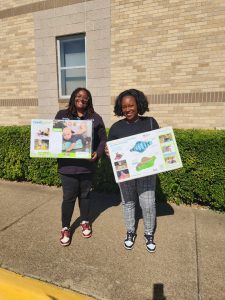 Cooks shares the responsibility of serving the entire district with three other colleagues in the O&M team: Barbara Mitchell, Briana Clarke, and T’Shaunda Davis.
“People hear ‘vision services’ and think of glasses or eye exams,” Cooks said. “But our work is about teaching students how to move through the world on their own terms—how to cross a street, get on a bus, find a classroom, and believe, ‘I can do this without someone holding my hand every second.’”
Her students range from tiny toddlers learning to crawl toward a sound, to high schoolers planning their first solo trip on public transportation. On any given day, Cooks might be teaching a child how to safely explore a playground, coaching a middle schooler to navigate a crowded hallway with a white cane, or helping an older teenager memorize bus routes to a part-time job.
“What we’re really teaching is confidence,” Cooks explained. “The cane is a tool. The route is a skill. But the goal is that moment when a student says, ‘I don’t need you to walk next to me anymore. I’ve got it.’ That’s when we know we’ve done our job.”
They support students both at a practical and emotional level, she said. Many students with visual impairments are the only ones on their campus. They rarely hear of another student using a cane or requesting large print materials. The pressure to blend in can be intense.
“Imagine being the only person in your school who uses a cane,” Cooks said. “A lot of my students will hide their tools or avoid asking for accommodations because they don’t want to stand out. My job is to show them that their tools are not a weakness; they’re a superpower.”
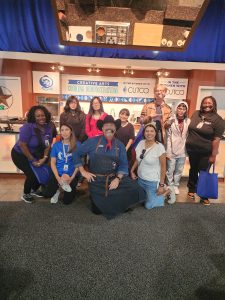 To combat isolation, Cooks and the O&M team organize events that bring students and families together. From a beeping egg hunt at Easter to Baby’s Day Out for infants and toddlers with visual impairments, these gatherings give students a space to practice skills and feel a sense of belonging.
“We want our students to be in a room and think, ‘I am not alone. There are other people like me, and we’re all figuring this out together,’” Cooks said. “When they meet peers who use canes, who advocate for themselves, who are proud of who they are—that changes everything.”
A big part of Cooks’ work is focused on teaching students to protect their autonomy. She runs roleplay scenarios where students practice what to say when someone grabs their arm without asking, moves their cane, or speaks to an adult instead of to them. Cooks said that students practice phrases such as “please don’t touch me without asking” or “talk to me directly” to assert a sense of autonomy and claim recognition from others.
However, her advocacy extends beyond students to the broader community. She urges adults to start with respect and communication when interacting with someone who is blind.
“When you walk into a room, make sure that you greet the person there, or let them know that you’re there,” she advised. “Always introduce yourself, and always ask if you can touch their cane or their body or their guide dog.”
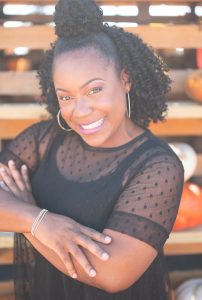 Cooks has also become an advocate for early mobility. Working with infants, she saw that many blind babies were late to crawl because they are carried to where they want to go. She went searching for a solution and discovered Crawligator, a tummy-time mobility device originally designed for babies with flat head syndrome. She immediately recognized its potential for her students.
“For blind children, the world only exists through touch. The Crawligator helps them get into a crawling position so they can independently explore their environment,” she explained. “It’s opening up not only a door to them being mobile, but to their vocabulary.” A partnership with Crawligator founder Stacey Kohler has brought the device to nearly 30 Dallas families, with plans for larger sizes and wider distribution.
Despite the long drives between 46 campuses and the constant juggling of schedules, Cooks remains energized by the moments most people never see: a student who finally trusts the cane enough to walk at a normal pace, a family who stops hovering and starts cheering, a young adult who texts to say they made it to college orientation on their own.
To her, mobility isn’t just about getting from point A to point B; it’s about access to education, employment, friendships, and full participation in life.
“Those victories might look small to someone else,” Cooks said, “but they’re everything to us. “Our students’ vision may be limited,” she said, “but their direction, their dreams, and their future are not.”