Contracts are coming

Human Capital Management is preparing to disseminate contracts for the 2026–2027 school year. Electronic contracts will be available for signature for all contract-eligible employees via Oracle Employee Self-Service by April 21. All contract-eligible employees will receive an email from notifications@dallasisd.org containing instructions on how to complete the acceptance process once contracts are available.

Team members should note that an assignment change into a non-contract eligible position will require the relinquishment of contractual rights.

According to the Texas Education Code, contract-eligible educators are provided a penalty-free resignation deadline 45 days before the first day of instruction of the coming school year. The resignation deadline for this year is June 27, 2026.

Additional information, frequently asked questions, and instructions may be found on the contract home page at www.dallasisd.org/contracts. If you have any questions, contact Human Capital Management at contracts@dallasisd.org.

Summer schedule is coming

Starting in June, the district will be closed on Fridays as central staff employees begin to work the summer four-day workweek and 10-hour days from 7 a.m. to 6 p.m.

 Monthly employees

  • Employees paid monthly will work the four-day workweek from June 1 through July 31.
  • Employees paid monthly will resume their regular work hours on Aug. 3.

Biweekly employees

  • Employees paid biweekly will work a four-day workweek from June 5 through July 30.
  • Employees paid biweekly who participate in the four-day workweek will NOT work on June 5 and will resume their regular work hours on July 31.
  • The district will be closed on July 3 for the Fourth of July holiday. To recognize the holiday, employees should work eight hours a day July 6-9. Pay for July 3 will be eight hours of paid time (for 260-day staff paid biweekly).

Juneteenth holiday

  • The district will be closed on June 19, 2026, for the Juneteenth holiday. To recognize the holiday, monthly employees should work eight hours a day June 15- 18.
  • To recognize the holiday, biweekly employees should work eight hours a day June 22-25. Pay for June 19 will be eight hours of paid time (for 260-day staff paid biweekly).

Employees are responsible for consulting with their supervisor to determine start, end, and lunch times of their daily work schedule during the summer. Employees approved to take a “working lunch” will only be required to stay at the worksite for 10 hours. Employees will be compensated for the “working lunch” time, and it will be considered part of the regular work hours.

Supervisors may allow employees to work a schedule other than the four-day workweek so long as the change does not negatively affect the department functions. Some departments may choose to return to the regular work schedule sooner. Decisions regarding the work schedule are at the discretion of the department supervisor. In addition, departmental leadership may modify work schedules of employees at any time to meet campus, departmental, or district needs. Any event such as New Teacher Academy or a back-to-school program may require a change to the work schedule in order to provide support.

Campus principals will make the determination to implement a four-day workweek based on the needs of their campus and executive director approval.

Summer Break

The district will be closed for Summer Break from June 29 through July 3. Employees will not be permitted to work for pay while the district is closed unless they have received prior written approval from their department chief. Central employees return to work on July 6.

Don’t forget to apply

The Dallas Education Foundation wants to remind team members about the deadline to apply for its fourth-annual Heart of Teaching Grant: Expanding Extracurricular Excellence.

The 2026-2027 Heart of Teaching grants program is designed to create opportunities for educators to support, enhance, and expand extracurricular activities on campuses. This initiative supports innovative projects that foster student engagement, leadership, and enrichment beyond the classroom. The maximum grant award will be $2,500 per project and must be used in the 2026-2027 school year.

DEF is accepting applications through April 26 from Dallas ISD campus staff, administrators, and teachers seeking to develop or enhance extracurricular activities. Grant applications may focus on launching new student organizations, strengthening existing programs, or introducing innovative initiatives that support student involvement. The application is open to all campus team members who serve students, including but not limited to, teachers, administrators, librarians, and support employees.

The team members who receive the grants will be announced on May 15, and the grants will be distributed from Aug. 1 through Sept. 30. Follow this LINK to apply. 

DEF serves as Dallas ISD’s direct and designated philanthropic partner. Our mission is to inspire community investment to accelerate student success. We align with the district’s strategic initiatives and partner with our city’s business leaders, residents, and philanthropic community to raise funds for programs that enrich the lives of our students. In 2025, DEF disbursed nearly $3.1 million to Dallas ISD to support students, teachers, and schools. To learn more, visit DEF at https://dallasedfound.org.

Guiding the path to college   

For students at South Oak Cliff High School, planning for life after graduation begins with the guidance of the counseling team. Leading this effort is Gala Smith, a school counselor who is setting the tone for a collaborative and compassionate environment that supports students.   

Smith understands firsthand what it takes to guide students toward their goals. She has served as a high school counselor at SOC for six years and credits much of her success to the strength of her team.  

“Counselors are patient, caring, and they have consideration for others,” she said. “We have great leadership skills and the ability to motivate our students.” 

Before transitioning to high school, Smith spent 18 years as an elementary and middle school counselor. Since her time at South Oak Cliff, she has built on that experience while developing new strategies tailored to the unique needs of high school students. 

Each year, students at South Oak Cliff earn college scholarships with the support of counselors like Smith. Through intentional guidance at every stage of the application process, she helps students while they craft essays that are strong, reflective, and most importantly, complete. 

In a recent effort to prepare students for college, the counseling program introduced College Culture Thursdays, an initiative that exposes students to a variety of college opportunities.  

A graduate of Alcorn State University, Smith earned her Master of Science in Secondary Education with a focus on school counseling.  

Each Thursday, she proudly wears her school colors, Alcorn gold and purple, sharing her school pride with students and encouraging them to explore colleges that can serve as the foundation for their academic, athletic, and social success.   

“I just want to make sure that students are successful in the next stage of their lives,” Smith said. 

Community service is another key focus within the counseling program. Smith regularly meets with parents to help students stand out in this area on their scholarship applications.  

At South Oak Cliff, the counseling team prioritizes strong relationships with parents and families to prepare students for college, but also to support their social emotional well-being.  

“As counselors we stand in the gap between the parents and students, helping families understand what is necessary for their child to be successful and to graduate from high school,” Smith said.  

For Smith, becoming a counselor has been a lifelong dream. After not feeling fully supported by counselors during her own high school experience, she knew that she wanted to help students in ways she once had to navigate on her own, alongside her parents. 

That experience sparked a passion for education, and she has spent the past 24 years in Dallas ISD helping prepare generations of students for success.  

“I hope that I’m inspiring them. I hope that they gain confidence they can carry with them,” Smith said. “Whether they plan to go to college, or enter the workforce, my purpose here is to inspire them to imagine more.”

Volunteering to bring joy to students and teachers

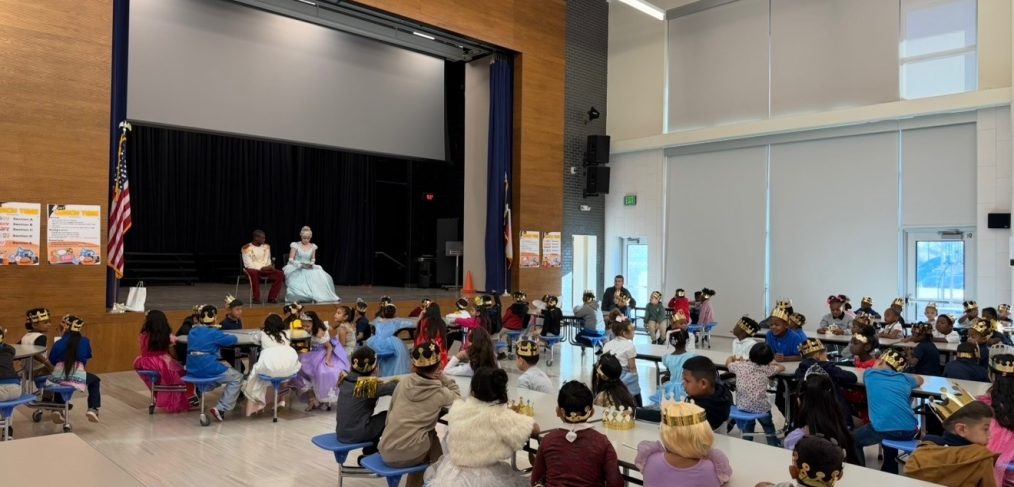
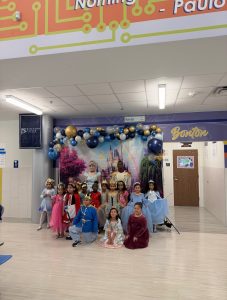
On a special day in first grade at H.S. Thompson Elementary School, the cafeteria didn’t feel like a cafeteria at all. The stage was framed by balloons and a colorful backdrop. Children arrived dressed as princesses, princes, and storybook characters. Then, to a chorus of excited whispers, Cinderella and Prince Charming walked in, took their seats on stage, and began to read aloud.

This wasn’t a district initiative; it was the vision of Carrie Bhasin, a volunteer who has become one of Thompson Elementary’s most dedicated advocates. Bhasin also represent one of thousands of volunteers in Dallas ISD whose contributions and efforts are being recognized during Public School Volunteer Week, April 20-24. 

“We hired Cinderella and Prince Charming to come to the school and read to the kids,” Bhasin recalled. “The teachers allowed the students to come dressed up that day, and then they got to have this kind of fairy tale party.”
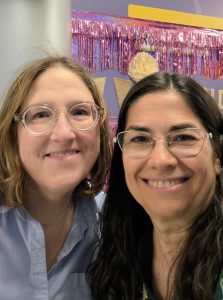
For Bhasin, the fairy tale celebration wasn’t just about costumes and photos. It was a deliberate effort to make reading feel magical, not just academic. The event wrapped up a first-grade fairy tale unit that Bhasin helped bring to life, literally, in collaboration with the teachers.

“My hope always is that the students are going to say, ‘Oh, remember in first grade when we had that fairy tale party?’” she explained. “I want those happy memories to stay with students, and, just as importantly, to anchor a lifelong love of books.”

Although Bhasin is now a familiar face on campus, her own children never attended Thompson Elementary or even Dallas ISD. Her connection to Thompson Elementary began when a staff member at TR Hoover CDC, the community center where her daughter volunteered, asked Bhasin if she would like to help at a local school. Bhasin agreed and it eventually led her to Thompson Elementary.

“Education was very important to our kids and to us. I just wanted to help a school that maybe needed some resources and some volunteer time; that’s why I do it,” Bhasin said.

About once a month, Bhasin visits a first-grade ESL classroom to read aloud and bring snacks. She also creates snack boxes so teachers have something ready for students who come to school hungry, and she keeps classroom treasure boxes filled with small prizes teachers can use for recognition and motivation.

“Every time I walk into that classroom, the children run up to me and they hug me and they yell my name,” Bhasin said. Those greetings, she added, touch her heart and reinforce why she keeps showing up.

Bhasin’s first major project at Thompson Elementary addressed a different kind of need—one that often goes unseen.

Shortly after the school moved into its new building, she and her husband funded and built a personal care closet on campus. Stocked with shampoo, conditioner, soap, and other hygiene items, the closet offers a discreet way for team members to support students whose families are struggling.

Over time, the effort expanded to include winter coats, socks, and other essentials. For Bhasin, it was a straightforward way to act on a deeply held belief: that students at every campus deserve the same basic support and dignity.

“I enjoy going there and seeing the benefit of our efforts,” Bhasin said. 

Another strong conviction—the belief that reading offers both escape, understanding, and insight—prompted Bhasin to undertake yet another signature project on campus: a book vending machine that she and her husband, Sanjay Bhasin, purchased for the school.

Filled with books at various reading levels, the machine is used exclusively for birthdays. Each student, on his or her birthday, receives a token and the chance to select a book to keep.

“The principal tells me all the time that the kids love being able to pick out any book they want,” Bhasin said. Students eagerly anticipate their turn, often asking, “‘My birthday is coming up—am I getting a book?”’

Carrie Bhasin is also committed to helping Thompson Elementary students build joyful memories at school. One of the traditions she’s most proud of is the annual daddy-daughter dance, paired with a separate mother–son night.

For each dance, Bhasin and her husband provide dinner, arrange for professional-style photos, and add a unique treat every year. One year, for instance, students and parents enjoyed Ben & Jerry’s make-your-own ice cream bar. Just this year, a caricature artist created keepsake drawings for each daddy-daughter duo.

“My kids were fortunate enough to have those experiences at their school, and they loved it. It made me realize that every child deserves that same opportunity,” she said.

Bhasin’s focus also extends beyond students to the teachers who care for them. Each month, she provides treats for teachers—coffee, cookies, sandwiches, candy jars—to acknowledge their hard work which she said is often overlooked.

“I think teachers are highly under-recognized in our society. They work harder than most people who have jobs,” she said. “They’re not just teaching math or English all day. They’re dealing with behaviors and all kinds of things.”

Bhasin and her husband have also helped fund field trips and teacher wish lists. Most recently, Bhasin and her husband agreed to support Thompson Elementary in its participation in the Disney Musicals in Schools program. The Bhasins’ support will help cover costumes, props, and other expenses so students can perform in a professional venue and work with theater coaches.

For community members who feel intimidated by the idea of getting involved, Bashin’s advice is simple: you don’t have to fund a vending machine or host a full‑scale dance to make a difference. Start small; show up.

“Just do it. Contact a school and say, ‘Hey, can I bring donuts for your teachers next Friday?’’’ she said. “Or just go read to a classroom. It’s very rewarding and very needed.”

In many ways, that simple encouragement sums up her mission as a volunteer: see a need, answer it; see a child, celebrate them; see a teacher, honor them. And then do it again.

“We’re so happy to be able to help, and we hope that things that we’re doing are benefiting the kids and helping them to love school more,” she said.


Celebrating the environment through art

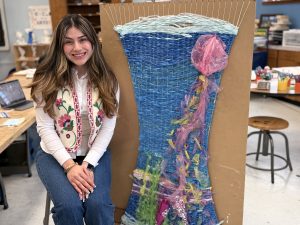
At Personalized Learning Preparatory at J.W. Ray, art teacher Carla Renteria is transforming plastic trash into a powerful lesson on ocean conservation and giving her students a platform in the Dallas art world along the way.

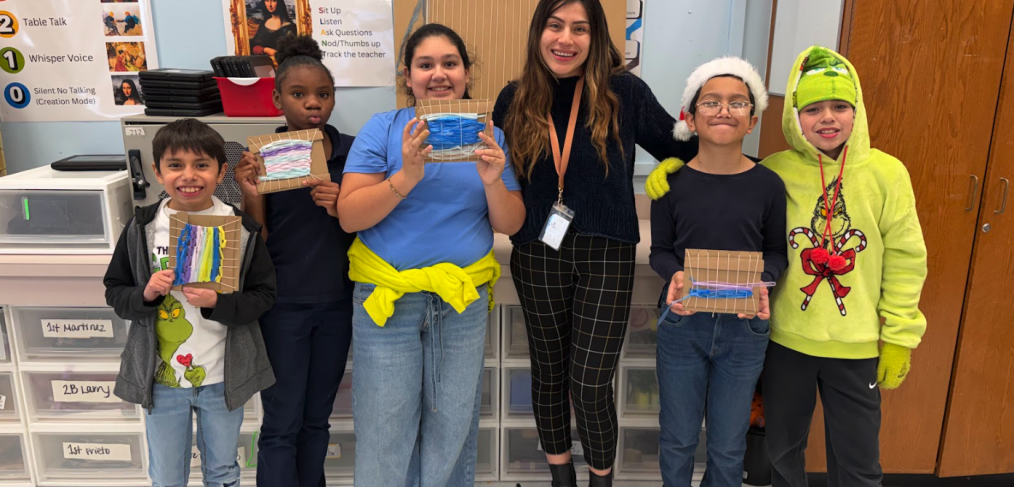
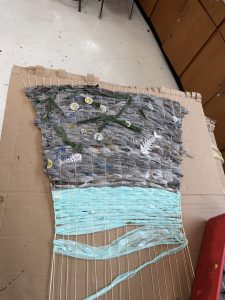
Renteria, founder of Artful Young Minds, has spent the past year leading third through eighth graders in an ambitious weaving project that blends environmental science, cultural tradition, and contemporary art. The installation, created with upcycled plastic bags on large cardboard looms, is inspired by Mayan weaving techniques and a documentary her students watched called Our Oceans.

Rentería’s lessons are on topic for April 22, Earth Day, which has been celebrated since 1970 to broaden and activate the environmental movement worldwide and to educate about ways in which everyone can have a part in saving the planet. 

“This project means a lot to us and our students,” Renteria explained. “We didn’t come to this technique right away. There was a lot of planning that we had to do in designing.” 

The project began with storyboarding different ways to protect the ocean, as students considered plastic pollution and other threats to marine ecosystems.

Initially, the idea was simply to reuse plastic as an art material, but research took the project much deeper. Renteria began looking into traditional Mayan weaving practices and discovered how some communities have adapted their textile traditions to incorporate plastic, both as a commentary on waste and as a way to tell new stories.
“The Mayans used to do it with textiles, but they decided to start doing it with plastic,” she said. “We are trying to promote art for our oceans, a positive message. And what better way than to upcycle plastic bags and create a story with it?”

The resulting work is a set of woven panels that contrast two visions of the ocean: one vibrant and thriving with jellyfish and coral reefs, the other littered with bottle caps, dead fish, and pollution. Through their research, students realized that plastic is only one piece of a much larger problem.

“We realized that the plastic is the minimum of the problem,” Renteria said. “They’re destroying ecosystems, which is what we decided that we want to promote, an ocean of how it’s supposed to look like, how it should be preserved for its beautiful coral reefs, its beautiful ecosystem and beautiful sea creatures that live around there.”

To help students understand those ecosystems more deeply, one of the science teachers visited the art club to explain how delicate and interconnected ocean life is. Renteria’s role was then to guide students in translating that understanding into visual narrative.

“It was about teaching students about how ecosystems work and how intricate they are and how delicate and fragile they can be,” Renteria said. “For me, my role was more like, what can we do now that we’ve learned [this information] and we’ve researched it, how can we use art as a vehicle to portray it, to express that.”

The creative process has been both technical and emotional. Students began by preparing large cardboard looms, threading yarn, and learning to cut and loop plastic bags so they could be woven in. They practiced on small looms before moving to full-scale panels. Then came the challenge of conveying a visual message on a woven plastic surface.

“What was really difficult was me trying to figure out, ‘Okay, how are we going to let people understand that this maybe could be a seaweed, or maybe this could be the coral reefs?”’ Renteria said. “We had to weave on top of all that, and that was something that I’ve never done before, so this project has pushed me also as an artist and teacher.”
As students gained confidence, their ideas became more sophisticated: plastic seaweed draping over damaged reef forms, abstract textures suggesting algae or debris, and bold color choices to balance devastation with hope.

“I can already see this is a story about that destruction, a story about how our ecosystem in the oceans need help, need protection,” Renteria said. “This is a race for help, but there’s also a glimmer of hope, because it’s gray, but then there’s blue.”

The project has also expanded students’ sense of what art can be. Many had never worked with plastic as a medium or considered themselves anything other than traditional artists.

“It really does open up their minds and see how you don’t just have to do a traditional art piece,” Renteria said. “If I’m a painter, I can be a weaver, too. I don’t want to just show them the traditional ways. I want to show them what other contemporary artists are doing today.”

Funded by a Heart of Teaching grant from the Dallas Education Foundation, the project has given students access to high-quality materials and, crucially, the chance to exhibit their work beyond the classroom. The woven panels are headed to Dallas City Hall this May, where students will see their art in a public space, an experience Renteria believes will be transformative.

“The students, for the first time, are able to show their art out into the community,” she said. “They’re seeing themselves as artists that are connecting into this Dallas art scene.”

That visibility has changed how seriously they approach their work. 

“It’s a lot more like they’re putting their A-game on,” Renteria said. “In a way, they feel that it’s like a way to show the art program that we have here, and that the art program has these art students with drive.”

For Renteria, the success is not just the finished panels, but the way her students now understand their own voices.

“It definitely has had an impact,” she said. “I’ve seen it with my own eyes in the way the kids talk; they’re quicker and more empowered to voice their artistic decisions. They have the ability to recognize that they have a voice and can use it. At the end of the day, that is what being an educator is about providing the space for them to fully express themselves.”

Administrative assistants make things happen

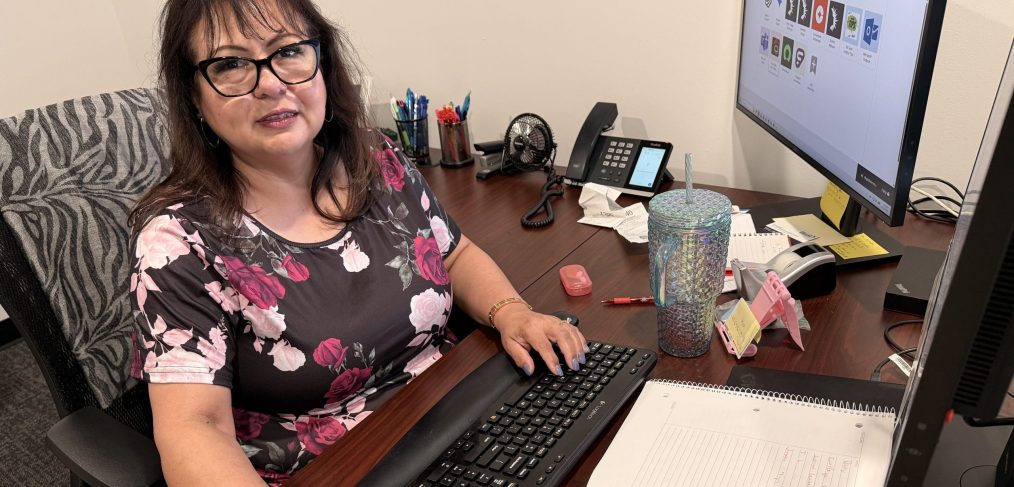
Margarita “Margie” Guzman doesn’t seek the spotlight, and she’ll be the first to say she’s just one person among many contributing to Dallas ISD. But for 31 years, she’s been a steady, welcoming presence, someone colleagues depend on for organization, support, and a kind word in the middle of a busy day.

Today, Guzman serves as the administrative assistant to Deputy Superintendent of Business Services Eduardo Ramos. Most of her work happens quietly in the background, but it’s essential to keeping her team prepared.

“Nobody sees what goes on behind the scenes,” she said. “The team spends quiet time working together to prepare for meetings, explaining how the budget works and where and why we need to make cuts.”

National Administrative Professional Day on April 22 recognizes the essential work of team members like Guzman, whose work behind the scenes often keeps departments and schools functioning. Guzman’s role is all about preparation and coordination. Every Monday, she sits down with her supervisor to review the week ahead.

“My job is essentially to make sure my deputy has all the paperwork and presentations he needs,” she explained. “We review his schedule on Mondays, giving me the rest of the week to prepare his books, binders, and any other necessary information.” 

She sets appointments, builds in travel time, sends reminders, and double-checks details so meetings go smoothly. Her job gets busier this time of year as Business Services prepares to have meetings in the community about the budget for the 2026-2027 school year. 

“My coworkers often tell me I’m always on the move,” she said. “But I don’t feel it, because I truly enjoy what I do.”

Guzman’s connection to Dallas ISD is deeply personal. Her story is part of a three-generation legacy. It began with her mother, who started as an attendance clerk at W.E. Greiner Exploratory Arts Academy—the same middle school Guzman attended—and later became a data controller serving schools across the district.



“When I started middle school, my mom was there,” Guzman remembered. “At first it was, ‘Oh, mom’s going to be at the same school,’ but middle school is scary. Having my mom there helped a lot.”

After graduating from Sunset High School in 1986, Guzman worked as a legal assistant at a law firm. She enjoyed the job, but the district kept calling to her.

“I enjoyed it, but my mom worked for the school district, and I was like, ‘I want to work where you work,”’ she said. 

It took multiple interviews over the years. “I went for several interviews, and then I’d stop, and then I’d apply again,” she said. Eventually, she was hired as an executive administrative assistant in student transfers.

Guzman spent 12 years there before moving to the former department of College and Career Readiness. A few years later, she followed a supervisor to School Leadership and then went to Academic Services. Finally, in 2018, she transitioned to Business Services. 

In Business Services alone, she has worked with four different chief financial officers, each with a different style.

“Anytime you get a new boss, you have to get to know them, their likes and dislikes,” she said. “Everyone works differently. You just have to be ready to accept it and go on with it.”

To do that, she has a simple approach.

“Within the first two days that I work with that person, I interview them,” she explained. “Are they morning people? Do they need coffee? Do they like to be bothered early or see me in the afternoon? They may be silly questions, but I need to ask so I can know.”

That thoughtfulness extends beyond supervisors. Guzman is especially mindful of how interns and younger staff are treated.

“They’re here to learn,” she said. “It might be a little task, but to them it’s something new, and you have to have the patience to teach that person. Always treat everybody the way you would like to be treated. They could be your next boss.”

Her sense of legacy is no longer just about her mother; it now includes her daughter Desmonise Robledo, who is an executive administrative assistant to the chief of Communication Services.

Robledo, also a Sunset High School graduate, credits her mother for teaching her how to thrive in the district. The most valuable lesson she learned from her was to “always carry yourself professionally and be open-minded and flexible.”

“I’m really proud of her as an admin,” Robledo said. “It’s an exciting position to be in.”

Even though they work in the same building, Robledo and Guzman don’t see much of each other at work, separated as they are by seven floors. 

“We work in the same place, but I still make sure to visit her on the weekends,” Robledo said. “It’s always been nice for me to know she’s just a phone call away if I have any questions.”

Knowing that three generations of her family have served the same school system means a great deal to Guzman. 

“I do like that legacy,” Guzman said. “It would be really nice if maybe my grandkids also got a job with the district.”

What keeps Guzman going, however, is simple: doing her job well and knowing it contributes, in some small way, to student success.

“When I leave, at least I know that I did my best,” she said. “I’m here in the background, but my work helps Mr. Ramos, who gets the job done to help the kids.”

As for how she wants to be remembered, Guzman doesn’t overcomplicate it. 

“I want to be remembered as a hard worker and a friendly person, as someone who was always willing to help,” she said.

Universal pre-K is here

During their March board meeting, Dallas ISD trustees unanimously approved offering tuition-free prekindergarten for 3- and 4-year-old students across the district.

Currently, the district offers free pre-K to students who qualify under strict federal and state guidelines, while other families pay tuition. Under the newly approved policy, the district will eliminate tuition for students who do not meet those qualifications—expanding access to early learning for more families.

“It’s a great idea,” said Dallas ISD Trustee Dan Micciche during the meeting. “I think it’s innovative and a good thing to do, and certainly our results have shown that.”

Pre-K registration for the 2026–2027 school year opened April 1. For more information, visit https://www.dallasisd.org/departments/early-learning/pre-kearly-learning.

Headshot opportunity for central 

Are you new to the district, never had a headshot taken, or simply due for an updated one? Now’s your chance to get your shot.

Dallas ISD central team members are invited to the next professional headshot session. This quarter there will be two separate days available: . The dates will be Tuesday, April 14, and Wednesday, April 15. Both sessions take place from 8 to 11:30 a.m. 

Each session will be held at the Linus D. Wright Central Administration Building, 9400 N. Central Expressway, Fifth Floor, Suite 583.

Updates to Quarterly Headshots

We’re adapting and improving our process to better serve the district’s growing photography needs. Here’s what’s new:

  • Quarterly Headshot Days: Professional headshots will now be offered once per calendar quarter.
  • Sign-Up Blocks: To reduce early morning backups, we’ll offer pre-signups with a larger time window so arrivals are spread out and lines are shorter. 
  • Deadline for Signup: Please sign up by midnight on Sunday, April 13.
  • Sign Up Required: To keep the line as orderly as possible, we ask that you must pre-sign up for a time spot to participate.

Who Can Attend:

  • Central team members
  • Campus principals (not available for assistant principals)
  • Executive directors
  • Associate superintendents
  • Chiefs and deputy chiefs
  • Board of Trustees

Important Notes:

  • Save to Your Calendar: Our signup system will now include a link after you sign up to add your date and time to your outlook or google calendar. 
  • Quick Sessions: Each session lasts about one minute. Multiple shots will be taken for your selection. 
  • Retouching: One image may be selected for retouching, which needs to take place before you leave.

SIGN UP HERE:  CLICK HERE

Sign with a new program

Starting June 30, Dallas ISD will transition completely from Docusign to Adobe Acrobat Sign as the standard tool for electronic signatures. 

To better support its growing digital workflow needs, Dallas ISD will begin transitioning to Adobe Acrobat Sign, which provides secure e‑signature capabilities, document tracking, and automated workflows—similar to DocuSign—while integrating seamlessly with existing Adobe Acrobat tools. 

To help team members get started and have a smooth transition, Edtech has provided a series of resources: 

  • Getting Started with Adobe Acrobat Sign 
  • How to Send Documents for Signature (single or multiple recipients) 
  • Configuring Send Options 
  • Creating a Document Template 
  • Archiving Your DocuSign Documents 


Getting Started Overview: Using Adobe Acrobat Sign 

https://experienceleague.adobe.com/en/docs/document-cloud-learn/sign-learning-hub/getting-started/beginner-users-overview 

Downloading Docusign envelops in bulk https://support.docusign.com/s/document-item?language=en_US&bundleId=iqw1600716424700&topicId=bjf1601927770187.html&_LANG=enus 

If you need technical assistance, please submit a ticket to the Service Now portal.