Celebrating the environment through art
At Personalized Learning Preparatory at J.W. Ray Learning Center, art teacher Carla Renteria is transforming plastic trash into a powerful lesson on ocean conservation and giving her students a platform in the Dallas art world along the way.
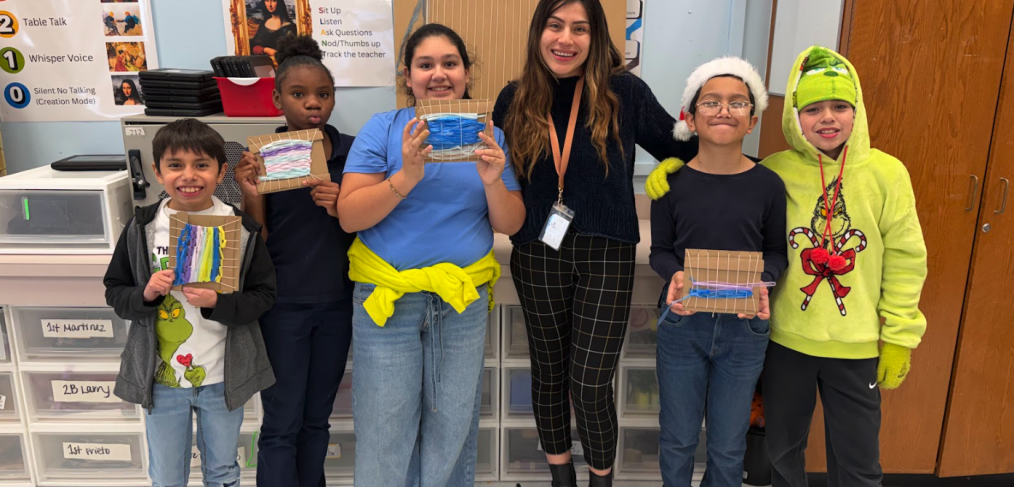
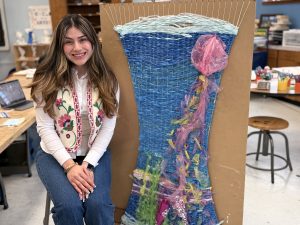
Renteria, founder of Artful Young Minds, has spent the past year leading third through eighth graders in an ambitious weaving project that blends environmental science, cultural tradition, and contemporary art. The installation, created with upcycled plastic bags on large cardboard looms, is inspired by Mayan weaving techniques and a documentary her students watched called Our Oceans.
Rentería’s lessons are on topic for April 22, Earth Day, which has been celebrated since 1970 to broaden and activate the environmental movement worldwide and to educate about ways in which everyone can have a part in saving the planet.
“This project means a lot to us and our students,” Renteria explained. “We didn’t come to this technique right away. There was a lot of planning that we had to do in designing.”
The project began with storyboarding different ways to protect the ocean, as students considered plastic pollution and other threats to marine ecosystems.
 Initially, the idea was simply to reuse plastic as an art material, but research took the project much deeper. Renteria began looking into traditional Mayan weaving practices and discovered how some communities have adapted their textile traditions to incorporate plastic, both as a commentary on waste and as a way to tell new stories.
“The Mayans used to do it with textiles, but they decided to start doing it with plastic,” she said. “We are trying to promote art for our oceans, a positive message. And what better way than to upcycle plastic bags and create a story with it?”
The resulting work is a set of woven panels that contrast two visions of the ocean: one vibrant and thriving with jellyfish and coral reefs, the other littered with bottle caps, dead fish, and pollution. Through their research, students realized that plastic is only one piece of a much larger problem.
“We realized that the plastic is the minimum of the problem,” Renteria said. “They’re destroying ecosystems, which is what we decided that we want to promote, an ocean of how it’s supposed to look like, how it should be preserved for its beautiful coral reefs, its beautiful ecosystem and beautiful sea creatures that live around there.”
To help students understand those ecosystems more deeply, one of the science teachers visited the art club to explain how delicate and interconnected ocean life is. Renteria’s role was then to guide students in translating that understanding into visual narrative.
“It was about teaching students about how ecosystems work and how intricate they are and how delicate and fragile they can be,” Renteria said. “For me, my role was more like, what can we do now that we’ve learned [this information] and we’ve researched it, how can we use art as a vehicle to portray it, to express that.”
The creative process has been both technical and emotional. Students began by preparing large cardboard looms, threading yarn, and learning to cut and loop plastic bags so they could be woven in. They practiced on small looms before moving to full-scale panels. Then came the challenge of conveying a visual message on a woven plastic surface.
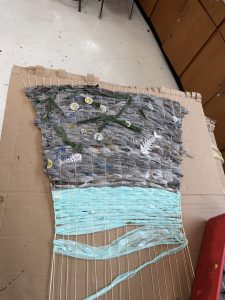 “What was really difficult was me trying to figure out, ‘Okay, how are we going to let people understand that this maybe could be a seaweed, or maybe this could be the coral reefs?”’ Renteria said. “We had to weave on top of all that, and that was something that I’ve never done before, so this project has pushed me also as an artist and teacher.”
As students gained confidence, their ideas became more sophisticated: plastic seaweed draping over damaged reef forms, abstract textures suggesting algae or debris, and bold color choices to balance devastation with hope.
“I can already see this is a story about that destruction, a story about how our ecosystem in the oceans need help, need protection,” Renteria said. “This is a race for help, but there’s also a glimmer of hope, because it’s gray, but then there’s blue.”
The project has also expanded students’ sense of what art can be. Many had never worked with plastic as a medium or considered themselves anything other than traditional artists.
“It really does open up their minds and see how you don’t just have to do a traditional art piece,” Renteria said. “If I’m a painter, I can be a weaver, too. I don’t want to just show them the traditional ways. I want to show them what other contemporary artists are doing today.”
Funded by a Heart of Teaching grant from the Dallas Education Foundation, the project has given students access to high-quality materials and, crucially, the chance to exhibit their work beyond the classroom. The woven panels are headed to Dallas City Hall this May, where students will see their art in a public space, an experience Renteria believes will be transformative.
“The students, for the first time, are able to show their art out into the community,” she said. “They’re seeing themselves as artists that are connecting into this Dallas art scene.”
That visibility has changed how seriously they approach their work.
“It’s a lot more like they’re putting their A-game on,” Renteria said. “In a way, they feel that it’s like a way to show the art program that we have here, and that the art program has these art students with drive.”
For Renteria, the success is not just the finished panels, but the way her students now understand their own voices.
“It definitely has had an impact,” she said. “I’ve seen it with my own eyes in the way the kids talk; they’re quicker and more empowered to voice their artistic decisions. They have the ability to recognize that they have a voice and can use it. At the end of the day, that is what being an educator is about providing the space for them to fully express themselves.”