District grows Montessori program from within
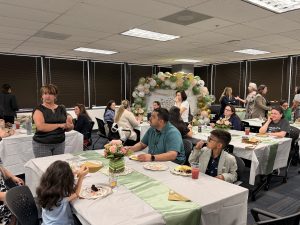
At a Montessori recognition ceremony earlier this semester, deputy chief academic officer, addressed a room of Montessori credentialed teachers with a childhood anecdote that stressed the need to offer this program in public schools like those in Dallas ISD.
Hill attended a Montessori program for one year when she was 4 years old. Decades later, she asked her mother, a retired teacher, why she didn’t keep her in the Montessori program.
“Do you know what she told me?” Hill paused to let the room think for a moment. “She said that it was too expensive.” Which is why, Hill said, what district Montessori teachers do for families is tremendous.
Providing Montessori programs in Dallas ISD gives students opportunities that they may not otherwise have had, especially in the public sector, she said.
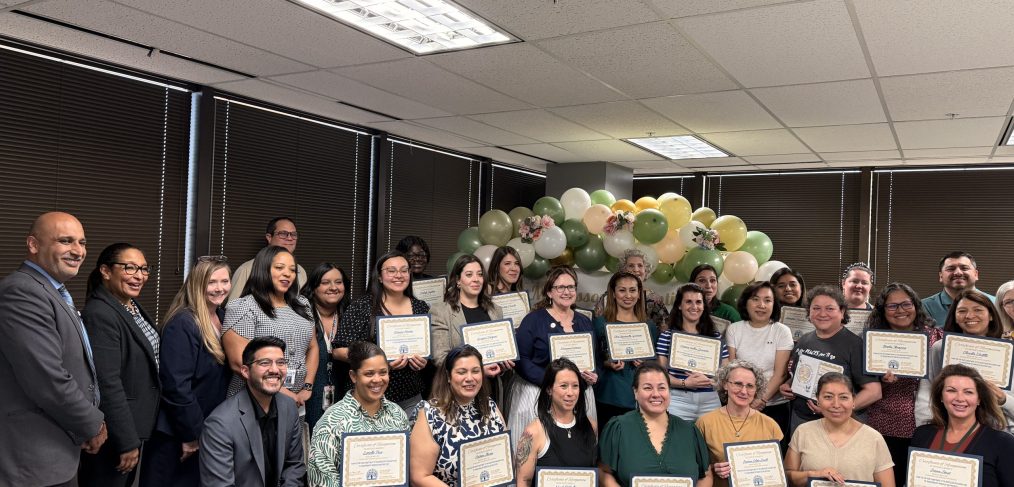
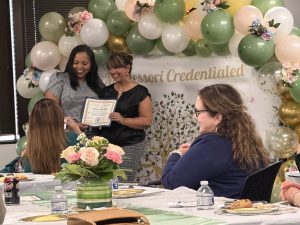 During the ceremony, the teachers received pins and certificates recognizing their Montessori credentialing, honoring their commitment to student‑centered education. Each one completed 300+ hours of MACTE-accredited training plus a nine‑month practicum. This training is funded by the district as part of its efforts to increase the number of credentialed Montessori teachers.
Rafael Ibarra, a Montessori teacher at Prestonwood Montessori at E.D. Walker and also a Teacher of the Year for Magnet/Choice nominee, said that it was a rigorous two-year training.
“I went through the E1 and E2 training, which is the lower elementary and upper elementary training,” he said. “It was during the summer and every other Saturday. It was 40 hour weeks of a certain content, a certain subject, and we had to write a lot of papers, but it was a great experience.”
Dallas ISD is growing a powerful Montessori pipeline that gives families more educational choices. In Montessori, classrooms are multi‑age and truly child‑centered. Students choose their work, move from concrete materials to abstract concepts, and take ownership of their learning. Educators are organized into three key levels: primary, which serves prekindergarten and kindergarten; lower elementary, which includes first through third grades; and upper elementary, which encompasses the older elementary students.
“Students are the focus. It’s an opportunity for students to have independence with guidance,” Bixby said. Since 2020, Dallas ISD has opened three new Montessori programs, bringing the total to eight campuses.
 “It was intense, but I’m really grateful that I was able to go through it because I learned a lot from my training,” said Marisela Rocha, teacher at Downtown Montessori at Ida B. Wells Academy. “It was rigorous, and we did it through Zoom during the COVID time pandemic, which was kind of like an experiment for everyone.”
For many teachers, the program offers a meaningful next step in their career. Montessori Executive Principal Tomeka Middleton-Williams closed out the event, emphasizing that Montessori belongs in public education. It is not privilege; it is access.
“Public Montessori requires courage,” she said. “It requires leaders in the classroom who can hold high academic expectations and deep respect for childhood at the same time.”
For Jeanne Elser-Smith, who taught Montessori in the private sector before joining George Bannerman Dealey Montessori Academy as a teacher, Montessori is more than a method—it’s a wonderful way to spend each day in a classroom where children are engaged, proud, and deeply connected to their learning, she said.
“We have to follow what the child is doing, regardless of their age,” she said. “It gives teachers freedom to actually meet the child where they are and move them on as far as they need to go.”
But the true joy, Elser-Smith continued, lies in watching children take pride in their work.
“The kids are happy because they love their work. They love it because it’s their work,” she said.