Assistant principal leading with values, elevating the game

Assistant principal leading with values, elevating the game

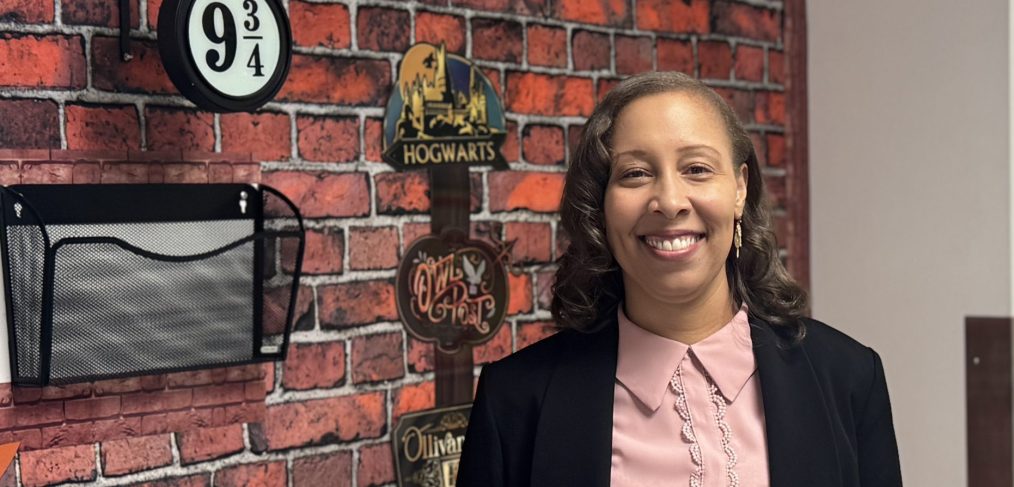
Great leaders often anchor their actions in core values that will help bring out the best in themselves and those around them. Cassie White Rodriguez, assistant principal at Buckner Terrace Montessori, leads by example, fostering a culture that inspires both teaching and learning through resilience, collaboration, and compassion. 

The week of April 6-10 is National Assistant Principal Week, to recognize the contributions these campus leaders make to learning and the school environment every day. 

White Rodriguez’s path to education began in her own childhood when school became a safe haven.  

“I had teachers who believed in me and made school interesting,” she said. “I knew I wanted to give back in that same way. Over time, I realized I could expand that impact beyond my own classroom by supporting teachers and students, which led me to pursue campus leadership as an assistant principal.” 

Her leadership journey was encouraged by her former principal, who reminded her that she belonged in rooms of impact. White Rodriguez gained the confidence to take steps beyond the classroom when she was still a teacher. That support led her to apply to the Aspiring Leaders Program at Southern Methodist University, a two-year master’s degree program designed for educators who want to become assistant principals.  

“One of the first classes we took was called ‘Leading with Values,’ a course that helped us take a deeper look into ourselves and identify our core values,” White Rodriguez said. “We learned how to use values to lead with integrity and unite a staff in achieving common goals. That experience gave me the confidence that I was on the right path.”
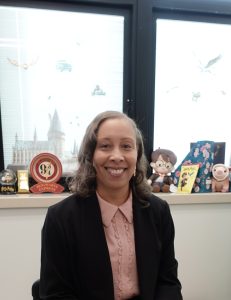
As an assistant principal, White Rodriguez prioritizes being an instructional leader. She remains visible in classrooms, supports teachers in refining their instructional practices, and helps solve problems in real time. She also builds meaningful relationships with students, encouraging and supporting them as they work toward their goals.  

Dallas ISD is celebrating its outstanding leaders with the theme “APs Elevate the Game.” Activities during National Assistant Principal Week recognize that they show up each day ready to take on challenges, support their campuses, and elevate outcomes for students and staff.  

“I believe leadership is about serving your school and community, while continuously growing to new heights,” White Rodriguez said. “It’s about listening more than we speak, building strong relationships, and leading with integrity.” 

For White Rodriguez, her success is rooted in never forgetting what it feels like to be in a classroom. 

She began her career at Buckner Terrace Montessori as an instructional coach in 2018, and after four years of teaching students in kindergarten through fourth grade, she stepped into her current role. 

Buckner Terrace Montessori school is a B- rated campus, earning a strong score of 88 from the Texas Education Agency. That success reflects the campus’ theme of “discovering the magic of learning” and its commitment to strong community partnerships and a dedicated focus on creating a positive environment.  

“I hope students remember that I believed in them,” White Rodriguez said. “I want my impact to be long lasting—not just in systems or programs, but in people. If teachers grow in their practice and students leave more confident and prepared because of the work we’ve done together, then that’s the kind of legacy that truly matters.” 


Help Dallas ISD celebrate assistant principals

In honor of National Assistant Principal Week, cast your vote for your favorite assistant principal across the district. Winners and prizes will be announced Friday, April 10.  To participate, vote here through April 8.

Teachers and staff can also join the celebration by participating in the AP Bingo Challenge, highlighting the many ways assistant principals elevate the game. To play:

  1. Click [HERE] to access your gameboard
  2. Take a photo for each Square
  3. Upload Photos into each box
  4. Complete the board. Elevate the Game BLACKOUT = POWER MODE



Team members go above and beyond

The Dallas Education Foundation announced that this year’s Employee Giving Campaign was its most successful yet with more than 2,600 donors, who raised $109,000.

“This achievement is a testament to our team’s deep commitment to our students and classrooms,” said Mita Havlick, DEF director. “A special thank you to our Campaign Champions—your leadership and advocacy truly led the way.”

This year’s campaign saw increased engagement with dozens of teams reaching 80% or higher participation.

Departments and campuses with 100% participation include:
Superintendent of Schools; Chief of Staff; Professional Standards Office; Human Capital Management; Legal Services; Gilbert Cuellar Sr. Elementary School; Partnerships and Volunteer Engagement; Small Business Office; High School Transformation; Student Services; Library/Media Services; Alternative Certification; Visual and Performing Arts; Counseling Services; Real Property Management; Special Populations; Multi-Tiered Systems of Support; Academic Enrichment and Support; Office of Family and Community Engagement; Treasury Services; Public School Choice; Student Activities; Benefits; Service Center(s); GIS and Demographic Analysis; Campus Culture & Academic Success; Federal and State Accountability; Marketing Services; Excess Resignation; Textbooks; and Central Operations.

Departments with 80-90% participation include:

  • Mechanical, Electrical, and Plumbing (98%)
  • Leila P. Cowart Elementary School (92%)
  • Financial Services (89%)
  • Leadership Excellence, Advancement and Development (86%)
  • Board Services (86%)
  • Cesar Chavez Learning Center (85%)
  • Budget Services Department (82%)
  • Science (80%)
  • Parent Advocacy and Support Services Department (80%)
  • Advanced Academic Services (80%)

Important reminders:

  • Payroll Deductions: These will begin in April.
  • Year-round giving: If you’d like to continue or expand your support, convenient credit card donations are always available.

Together, we are creating new opportunities and changing the trajectory for students across the district, Havlick said.

Recognizing the Core 4 team members

As the 2025-2026 school year enters its last weeks, it’s time to recognize team members who have embodied the district’s tenets by which all Dallas ISD employees strive to meet the needs of students, their families, and one another—the Core 4.

Each tenet is at the “core” of everything we do and anchored in our district focus of educational excellence, comprehensive accountability, responsible use of resources, and collaboration.

If you know of a team member who has embodied one or more of these tenets during the year, let us know using this form, so they can be recognized. Make sure you provide concrete examples that match the category for which you are nominating them. 

Need to review what the Core 4 tenets are all about? Check them out below.

Focused—We transform student lives

  • Decision making is consistently and effectively made in the best interest of students and results in improved outcomes
  • Systemically monitors supports and evaluates multiple data sources to maximize student achievement through differentiated supports
  • Without exception, tightly aligns differentiated resources to district priorities to ensure outcomes for all students
  • Consistently and effectively implements supports to ensure the social, emotional, and academic needs of students, families, and employees

Fast—Urgency for all

  • Without exception, emails and phone responses are timely, and requests or incorporates feedback to improve culture
  • Proactively and effectively leverages all available data, policy, and information sources to provide accurate responses to all requesters
  • Models effective time management by anticipating needs and differentiating task importance in providing timely and accurate responses to requests between students, families and employees
  • Consistently and effectively solves problems before they arise and adjusts for unforeseen circumstances to ensure excellent outcomes

Flexible—We strive for the yes

  • Embraces and responds appropriately to social variances, creating synergy and inclusivity. Proactively solicits different perspectives to strengthen the decision making process and support positive outcomes. 
  • Creates intentional opportunities for inclusive collaboration that promote flexibility, innovation, and productivity
  • Communicates rationale for change in a clear, concise, timely manner that garners support from all families, employees students
  • Adapts to change with versatility and optimism providing stability and eliciting trust among stakeholder groups

Friendly—Make memorable moments

  • Proactively and intentionally builds, maintains, and leverages professional relationships and positively influences others to advance goals and close achievement gaps
  • Creates intentionally a welcoming, inclusive and respectful working environment by adapting to the needs of others and tailoring interactions to meet their specific needs
  • Models friendliness and professionalism in communications and influences others to improve their communications skills

Soccer match provides lessons in leadership

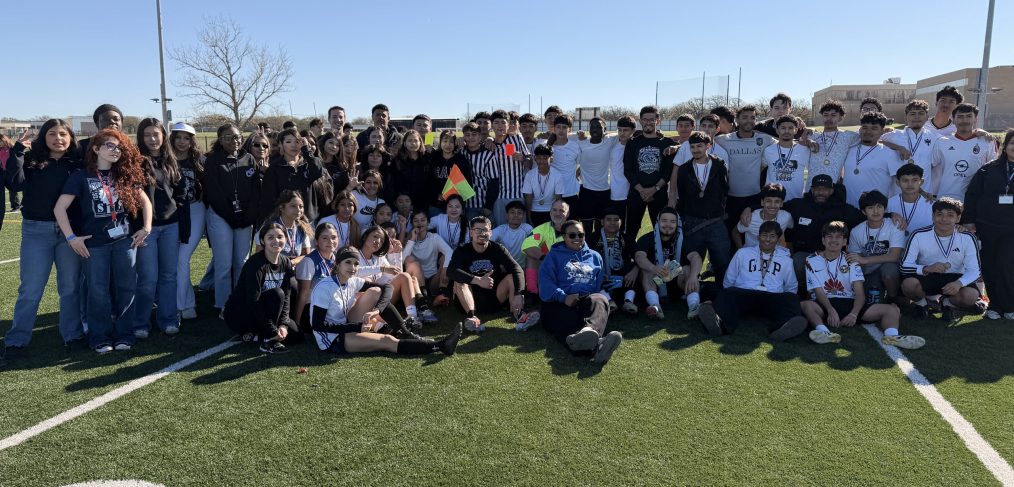
On an unusually cold Thursday morning in March, Seagoville High School students and team members filed out onto the soccer field after morning announcements. With a field bathed in sunlight, the anticipation of spring break in the air, and music blasting from a sound speaker, they all got ready for the kickoff of the first ever soccer match between staff and student athletes. 

Headed up by teachers Yennifer Reyes, Daniel Seelig, and Jennifer Wallens, the soccer match was intended to raise funds for Link Crew, a program that pairs up freshmen with upperclassmen who can help them navigate the high school experience. The proceeds from the match, he said, will go to booking an escape room which will serve as a team-building exercise for the final Link Crew leadership training.

“This was an idea that the kids had, and we are just supporting them in their passion for soccer and to unite the school and do something fun for our campus,” said Reyes.

This initiative builds on a tradition of teacher-versus-student games, which in the past have featured basketball. This year, the students shifted to soccer, opening the door for a new kind of experience. Seelig explained that an essential part of education is also allowing students to lead.

“I think that teachers can sometimes take a step back and let students lead,” he said. “Just letting young people take leadership is rewarding for them.”

The students did all the planning and ticket sales for the match, Seelig said. The teachers facilitated to ensure everything was working for success. 

Representatives of the recently opened soccer club Atlético Dallas, including head coach Peter Luccin and professional soccer player Lee Benting, were in attendance. They were also assigned a team to coach. Inspired by the collective glee, Benting ended up dribbling with a group of students standing off to the side and later joined the main game.

“We’re just here to be present in the community and have some fun,” said Jeremy Jones, Atlético Dallas marketing director. As the wind blew cold and chatter carried across the field, cheerleaders, dressed in vibrant black and blue, took to the turf in staggered rows with their pom-poms rustling at their sides. Students and staff members donning shorts and white T-shirts ran through the tunnel of cheerleaders

“My husband is the director of Marketing for Atlético Dallas, and so I told him about the match and invited his team to come out here,” Wallens said. “I wanted the kids to feel that sense of professionalism—getting professionally coached and having that really awesome marketing experience for the school.”


The timing was intentional: students had been working hard on their growth goals, and this game served as a celebration of their effort and progress. The result was a week of excitement leading up to the event and a strong turnout on the day of the game.

“We wanted to bring the kids and teachers together to build relationships, have fun, and celebrate our success and growth,” said Wallens. “It was a big opportunity for us and gave the kids a chance to really get involved.”

As the game began and players dribbled in tight quarters, switched play, or arced the ball through the air, it seemed there would be no clear winner. Every time the ball sailed too closely to either goalpost, the goalkeepers caught it effortlessly. After about 45 minutes, the match ended in a tie and with cheers from both sides.

As participants gathered for a final send-off and a group photo, Luccin, who had been observing the game, selected two MVPs from among the student players and awarded them swag from Atlético Dallas. With the event concluded, students marched back to their classrooms, but the excitement of the morning still buzzed in the air.

“It’s fulfilling to see all the students—and all their hard work—turn into something as cool as this soccer game,” Seelig said. “The more effort you put into students, the more they show that effort back to you, and it’s really rewarding.”

Reading soars at Dallas ISD

For many, one of the simplest, but most fulfilling, pleasures in life is reading. There is no greater enjoyment than inhabiting universes that arose out of someone else’s imagination, entertaining ideas of men and women long gone, and learning new information that expands knowledge of the world. And libraries are where these new worlds are readily available. In honor of School Library Month, celebrated in April, librarians are encouraged to host activities that reinforce the vital role that school libraries play in empowering learning. Thanks to changes in schools, such as the device-free policy, foot traffic in libraries has increased, and Library Services has provided recent statistics that point to a resurging interest in reading.

Annual circulation metrics

Total districtwide circulation reflects a significant commitment to the culture of literacy standard, ensuring students have access to a diverse range of print and digital materials.

Metric Category Current Year-to-Date Performance
Total districtwide checkouts (physical books) 766,548
Total digital checkouts (Sora eBooks and audiobooks) 233,819
Circulation growth (comparison to prior year) 21% Increase
New titles added to collections 47,522

Circulation trends and impact

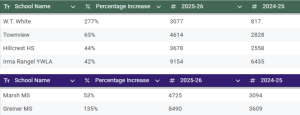
The 21% increase in physical book checkouts suggests a positive response to the district’s new device-free policy and other programs that encourage reading, with librarians reporting a noticeable surge in library traffic and reader engagement. This growth aligns with the district’s goal to push circulation back to pre-pandemic highs. See graphic below for larger increases at specific campuses. 

Top performing titles by school level

These titles represent the most frequently checked-out materials through the LS2 PAC system, demonstrating student reading preferences across various grade bands.

Elementary School

  • Fetch 22 by Dav Pilkey
  • Creepy Crayons by Aaron Reynolds
  • Cabin Fever by Jeff Kinney
  • Selena by Patty Rodriguez

Middle School

  • Invisible by Christina Diaz Gonzalez
  • Hard Luck by Jeff Kinney
  • The Princess Diaries by Meg Cabot
  • One Dead Spy by Nathan Hale

High School

  • Long Lankin by Lindsey Barraclough
  • The Pit and the Pendulum by Sean Tulien
  • Killer Instinct by Jennifer Lynn Barnes
  • Scarlet by Marissa Meyer

Campus leadership in circulation

The following campuses currently lead the district in total circulation, serving as models for effective reader advisory and library engagement strategies.

Top elementary campuses

  1. Lakewood Elementary School
  2. Sylvia Mendez CREW Leadership Academy
  3. Annie Webb Blanton Elementary School
  4. Rosemont Primary School
  5. F.P. Caillet Elementary School

Top districtwide campuses (Cross-Level)

  • Lakewood Elementary School
  • Sylvia Mendez CREW Leadership Academy
  • The School for the Talented and Gifted in Pleasant Grove
  • Henry W. Longfellow Career Exploration Academy
  • Irma Lerma Rangel Young Women’s Leadership School
  • Hillcrest High School

The library as an innovation and AI hub

Beyond traditional circulation, Dallas ISD libraries have evolved into primary spaces for foundational computer science and emerging technology under the Inquiry and Innovation standard. Librarians track hands-on lessons that prepare students for a technological society. This year, thousands of students engaged in:

  • Robotics and coding: Learning foundational logic with Bee-Bots and Ozobots.
  • Emerging tech: Participating in 3D printing, podcasting, and the “Hour of AI”.
  • AI literacy: Receiving direct instruction on prompt engineering, ethical AI use, and digital media creation using tools like Google Gemini, Adobe Express, and Canva Pro.

Keeping an eye on stress

The spring semester brings with it the excitement of a new season, the sprint to the end of the school year, and many other things to celebrate. It also brings with it the anxiety of testing, meeting goals and other expectations that can cause stress for students and team members. 

April is Stress Awareness Month, and according to mental health experts, stress can be good or bad as the body’s natural physical, mental and emotional response to life’s challenges, threats, or changes. 

“When you are faced with a challenge or situation that’s stressful, your body releases hormones like adrenaline and cortisol to increase alertness and energy,” said Annmarie Perez, licensed psychologist and quality assurance manager with Mental Health Services. “It can be positive, for example, increasing motivation. But it can be negative if it causes anxiety or if it becomes chronic.”

And it is when stress becomes anxiety or lasts for a long time that it can become a problem, especially for students. Students not only face the stress of testing, homework, graduating, moving to another grade level or school during the spring. They also face stressors at home or from social interactions that teachers or counselors might not know about. This is why team members at the campuses are trained to look for signs of stress:

  • Physical: headaches, fatigue
  • Emotional: irritability, outbursts, anxiety
  • Behavioral: changes in sleep or appetite, withdrawing, different behavior in class
  • Cognitive: problems concentrating, forgetfulness, negative thoughts

“There are stressors all around that can affect children even if we are not seeing them, like the uncertainty of what is going on in the world, financial changes for their families,” Perez said. “Kids pick up on these feelings even if they don’t have the tools to verbalize them.”

Students who are constantly stressed can’t learn as effectively, she said. And when stress becomes overwhelming or chronic, it can interfere with daily life, including learning. 

This is why Dallas ISD has invested in the mental health of students, she said. Each campus has a school-based mental health clinician and counselors who are also there to help students manage stress and other challenges so they can learn.The district also has help through the district’s Youth and Family Centers and can connect students and families with resources in the community.

Teachers can model healthy coping mechanisms for kids and provide a safe place without judgment so that students can express themselves when they have problems, Perez said. They can do things in class as a matter of routine to help with stress, especially during times of high stress, such as breathing exercises, doing a physical activity, having a time for drawing or painting, role playing, or providing the vocabulary they need to express their feelings. Other ways to fight stress include making sure that students are hydrated and are eating nutritious food. 

“Teachers are often the first ones to identify when students are going through something or have a change in behavior because they spend so much time with students,” Perez said. “That is why we emphasize building relationships so that students can ask for help.”

Helpful links for breathing exercises and other resources:

https://www.childrenscolorado.org/just-ask-childrens/articles/breathing-exercises-and-mood-regulation/

https://spurgeons.org/resources-and-courses/resources/mental-health-resources/breathing-techniques-and-mindfulness-exercises/box-breathing-exercise/

https://www.youtube.com/watch?v=RiMb2Bw4Ae8

https://health.choc.org/7-stress-relief-techniques-for-kids/

https://www.apa.org/topics/children/stress

Parent forum

To help families discuss mental health issues, Dallas ISD is holding the Empowering Families Parent Education Forum at 9:30 a.m. on Saturday, April 18, at Barbara Mann DAEP in the Buckner Building, 2909 North Buckner Blvd.

This year’s event offers an opportunity for parents and community to learn about social media dangers and addiction, youth substance misuse and abuse, and how to support a child who is struggling with anxiety and depression. The keynote speaker will be Cristal Retana Lule, vice president of Government and Community relations with Children’s Hospital.

There will be an opportunity for confidential conversations with staff from Dallas ISD Mental Health Services, Parent Advocacy and Support and other resources.

Preparing generations of health workers

March is Women’s History Month, which was established in 1987 to recognize women’s contributions to history, culture, and society and highlight their vital role in many areas, such as education.  

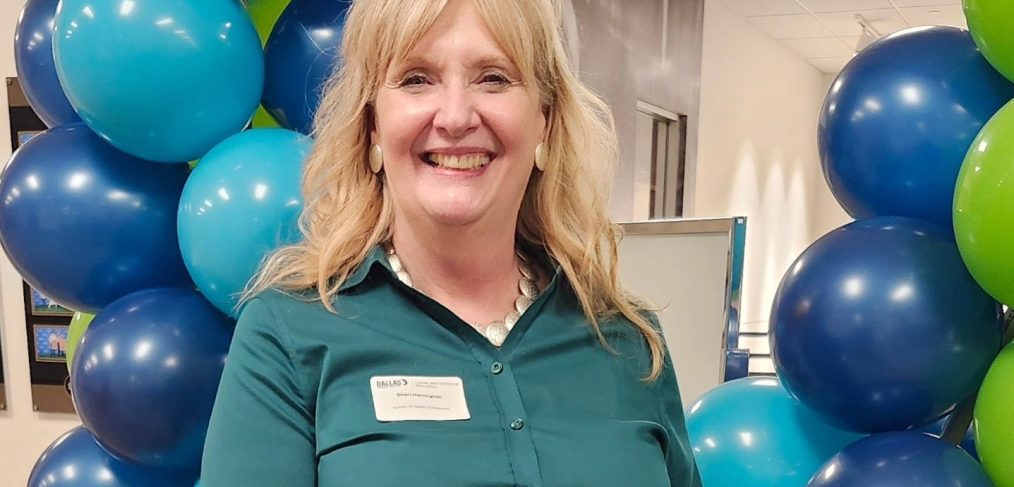
When cluster coordinator Shari Harrington started teaching at the School of Health Professions at Yvonne A. Ewell Townview Center in 1995, she was a young medical laboratory scientist stepping out of Parkland Hospital’s microbiology lab and into a high school classroom. Three decades later, she’s become the living memory of the School of Health Professions, a school whose influence stretches across Dallas-area hospitals, clinics, and dental offices.

The story, she explained, begins long before Townview Center existed.

“Our programs actually started in 1972 at Skyline High School, and we had a medical lab and a dental lab program,” Harrington recalled. “Then in 1977, because of the desegregation court order, the School for Health Professions was started.”

Those original programs—the medical lab and the dental lab—formed the backbone of a new specialized high school. In 1995, the school moved again, this time into the newly opened Townview Center. Harrington’s first year in the classroom was also Townview’s first year in operation. 

“The original teacher that started in the health professions program in 1972 was Patricia Kidd,” Harrington said. “She became the coordinator in 1995 when Townview opened.”

In all this time, Harrington has carried forward the work of her predecessor: to prepare the health magnet’s students to thrive in healthcare.

Today, students who have completed foundational science courses in the ninth and 10th grades can choose from five two-year pathways in the school: clinical medical assisting, dental assisting, exercise science, medical laboratory, and patient care technician. Each pathway combines rigorous academics with hands-on practice and industry-recognized certifications.

In medical assisting, students learn to work the front desk and the exam room—scheduling appointments, taking patient histories, and recording vital signs. They can graduate with both a medical assisting certification and an insurance billing and coding certification, positioning them to work while they pursue college degrees.

“For a high school to be seeing real patients is very unique,” Harrison said. “The students are able to get that real life experience.”

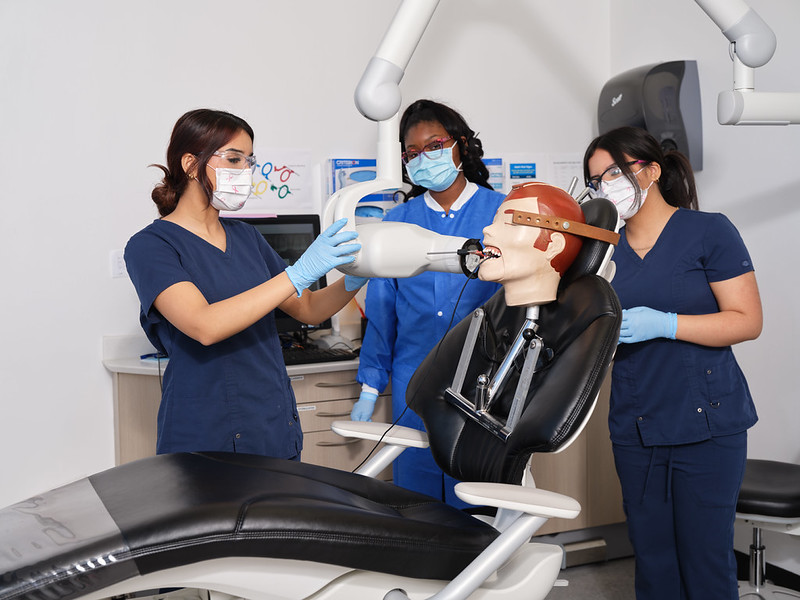
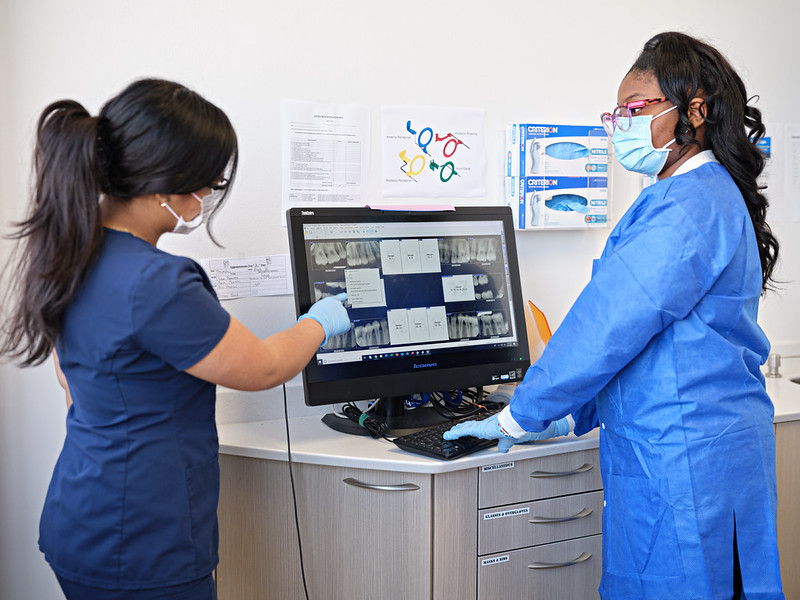
The program contracts with two dentists who come to campus one to two days a week from mid-October to mid-May. Working closely with nearby elementary and middle school nurses, the program identifies Dallas ISD students in the surrounding neighborhood who need dental care but might otherwise go without. Students also help schedule appointments, take X-rays, manage digital dental software through a partnership with dental supplies company Henry Schein, and assist chair-side during fillings, extractions, and cleanings.

“Henry Schein has provided us with access to clean clinical dental software so the students can learn to do all the administrative tasks that they would need to do in a dental office,” Harrison said. “The students even take X-rays on real patients, and we have a 100% pass rate for most.”

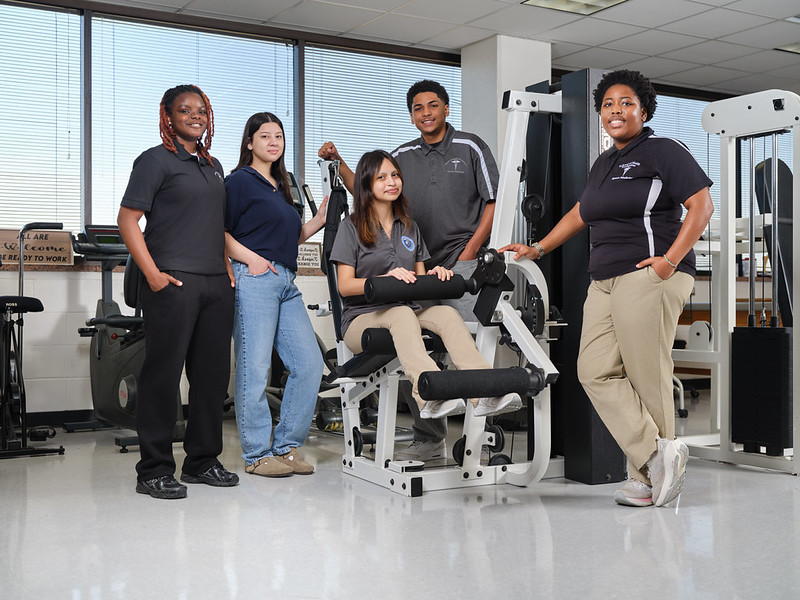
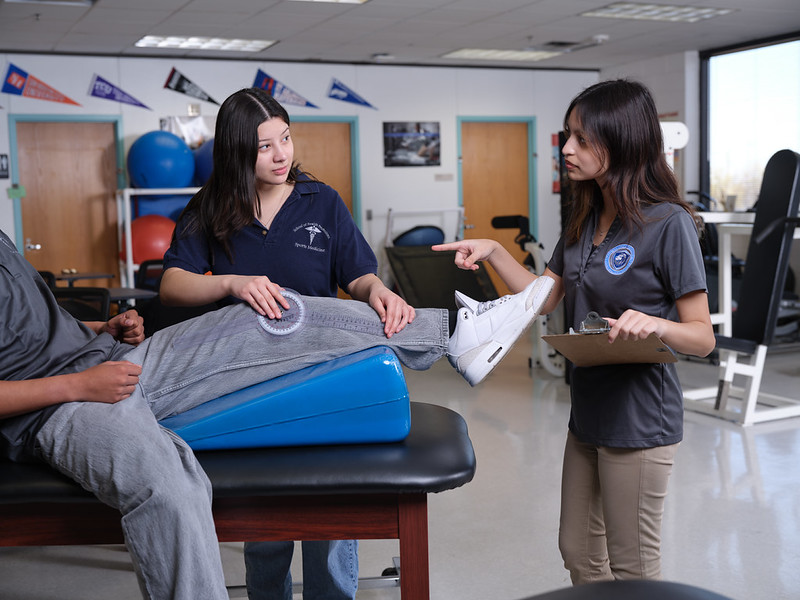
The exercise science pathway serves students interested in physical therapy, occupational therapy, speech therapy, and athletic training. Juniors intern at rehab facilities, hospitals, and nursing homes, and seniors return to their home campuses to work with Dallas ISD athletic trainers across sports seasons. 

“For our exercise science, students do EKGs on live patients. They also practice all of those skills on each other, so they’ll be able to do it properly once they’re out in the real world,” Harrison said.

Dating to 1972, the medical laboratory pathway is the longest-running strand. Students learn to collect, process, and interpret samples, practicing both finger sticks and venipuncture and earning Phlebotomy Tech and Medical Laboratory Assistant certifications.

Harrington said that for students who want to be in healthcare but not necessarily hands-on with patients, this is the perfect option.

“Sometimes, if you’re interested in healthcare, but really not interested in working and touching patients, that’s a good one to do,” she said. “Because it is such a science-based, laboratory-based program, it’s going to help you with every science class you take in college.”

The patient care tech pathway is a dual credit track, limited to 32 students because of Dallas College requirements. Juniors work in nursing homes, while seniors gain experience in hospitals. Along the way, they earn dual credit, patient care tech, and phlebotomy certifications, and many graduate with a Dallas College certificate already in hand.

Pre-COVID-19, Harrington estimated that about 95% of students–-who qualified on grades, attendance, and behavior—were placed in internships.

“We’re probably back up to about 90% of students who are qualified to go to internships, and we’re hoping to return to that 95%,” she said.

Students have interned in such institutions as UT Southwestern, Methodist Dallas Medical Center, Scottish Rite for Children, as well as private physicians’ offices and research laboratories. Some end up working where they interned, and others return every summer to their internship placement until they graduate from college or professional school.

“There’s probably not a hospital or healthcare facility that you could go to in Dallas that doesn’t have at least one of our students working there,” Harrington said.

Over the years, many graduates have come full circle: one former dental student is now one of the program’s dentists. Others have become dental hygienists while several nurses and a nurse practitioner who graduated from Townview now visit as professionals. Some have even come back as teachers. And, increasingly, alumni are returning with their own children.

“Seeing a former student come in with their child applying to our school is rewarding,” Harrington said. “It’s starting to happen more frequently, and it’s always awesome to connect with that graduate and to know that their child is now interested in us, too.”

But for Harrington, the work is about more than certifications or even college readiness. For Harrington, the work is about the future, about shaping the people who will one day care for her, her colleagues, and the wider Dallas community.

“We’re educating our health care providers that are going to take care of us when we get old,” she said. “We’d better do a good job.”

Achieving success on a national stage

Late one evening, at Victor H. Hexter Elementary School, librarian Yasmeen Youngblood opened an email that would quietly place her on the national stage.

A longtime colleague, she said, had nominated her for the Scripps National Spelling Bee Educator of the Year Award, which recognizes school staff who go above and beyond to encourage a love of spelling. She is one of the finalists for the award. 

“I didn’t know that the award existed at first,” she admitted. “We were both here late one night, and the email came through for both of us. And I was just like, ‘Oh, what is this?’”

At first, it seemed like a routine inquiry. The message simply asked whether she would be available for a Zoom interview the following Monday. Only after participating in that meeting did she realize the scope of the honor.

“The representative from Scripps called and asked if we could do another Zoom,” Youngblood recalled. “She told me then that I was one of the finalists. I was just in shock. I could not believe it. I went running down the hallway telling all my co-workers and my principal. It just feels unreal.” 

Youngblood grew up in Michigan and did not start her career in Dallas ISD in 2007 expecting national recognition. She has spent nearly two decades at Hexter, primarily teaching fifth-grade English language arts and social studies before becoming the campus librarian.

Her first dream, however, was journalism. She studied communications and journalism at Grambling State University and even secured an internship with The Dallas Morning News. But when she prepared to move from Michigan to Texas, her parents urged her to find a full-time job rather than an internship. That push led her to an alternative certification program and into the classroom.

“I thought, ‘Okay, maybe I won’t be a writer, but I can teach my kids writing,’” she said. Over the years, that decision has been affirmed again and again.

“Just last spring, I had a student who’s now in college visit me and say, ‘The things that you taught me, the way you taught me to write in fifth grade, I carried those same skills into college. You’re the one who made me a writer,’” she said. “That definitely solidified that I made the right choice.”

Youngblood’s recognition from Scripps is closely tied to the spelling bee culture she has built at Hexter.

Her own connection to spelling bees goes back to her time in seventh grade, when she competed and placed in the top group, even though she did not win. Her English teacher made a banner honoring students who had done well.
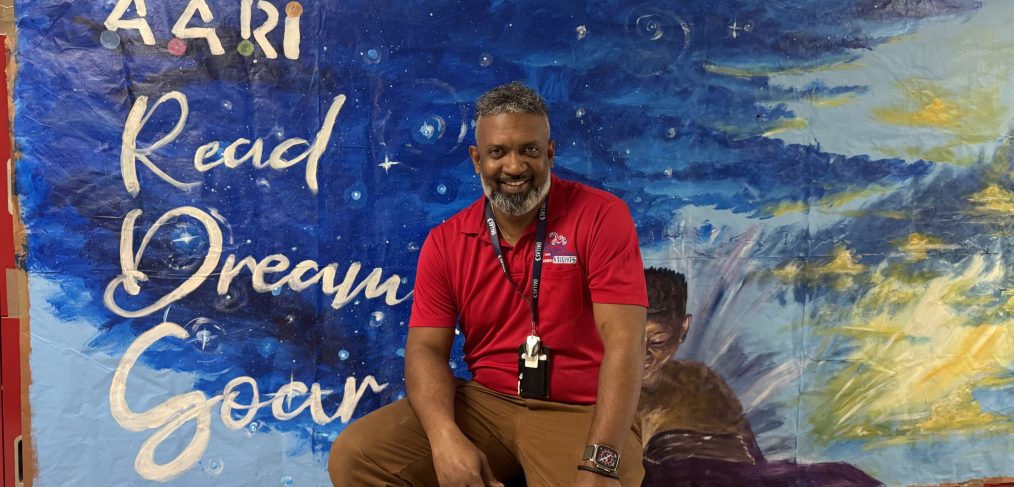
“All year, that banner hung in her room, and it had my name on it,” she said. “It made me into a better student, just because people then expected that of me. I knew the power of being visible and of people seeing you as a high-achieving student.”

When she arrived at Hexter, the school’s spelling bee was a modest affair, held in a classroom with a handful of selected students.

“I asked the next year if I could take it over,” she said. She formed a committee, moved the event to the auditorium, invited parents and students from multiple grade levels, and opened participation to anyone who qualified. 

“It just became this big event,” she said. “It became part of the culture at Hexter. Kids started aspiring to it.”

That visibility, she explained, changes how students see themselves and how others see them.

“I noticed that when they did well, they were treated differently by peers, because now they had done this great thing,” she said. “As their classroom teacher, I could see them trying harder in other areas as well.”

One former participant stands out in her memory: a “cool kid” who didn’t usually enter academic competitions and was also bilingual.

“He got in the spelling bee, and he was knocking out all the kids who were typically great students,” she said. “He’d walk up to the microphone all cool, spell the word, and go back to his seat like, ‘Yeah.’ You could just tell the crowd was like, ‘Wow.’”

His performance helped more bilingual students see themselves on that stage. For Youngblood, spelling is about more than memorization.

“Really, it’s all about patterns and word origin,” she said. “Whether a word has Greek, Latin, or French roots or whether it has long vowel sounds or short vowel sounds.” 

While she credits the lower grades with teaching students to read, she has been a strong voice on her campus for keeping spelling instruction in every grade. She created her own spelling curriculum and advocated for it in campus meetings.

“Spelling is important,” she said. “The kids are really reliant now on spell check, because everything’s on Chromebooks. I was noticing a decline in their ability to spell for themselves.”

Her concern is not just about correct spelling; it’s about students’ ability to express ideas in writing.

“A lot of times what holds them back from even getting their ideas out is the fact that they can’t spell the words,” she said. “I want them to be writing. I want them to be confident in spelling so their ideas can get onto paper.”

When Dallas ISD launched an initiative to place a librarian in every school, Youngblood transitioned from the fifth-grade classroom into the library. Now, instead of teaching one grade, she teaches prekindergarten through sixth grade in what she calls a “teaching library.”

“The kids come to see me once a week, and I target specific skills,” she said. Youngblood also analyzes TEKS and assessment data, coordinates with classroom content, and builds lessons that support literacy across the campus. The new role, she said, has helped her better understand how students grow as readers over time.

“It’s really enlightening for me to see that progression, going from being able to decode to actually reading for comprehension,” she said.

Looking ahead, Youngblood hopes her legacy in Dallas ISD is about what students believe about themselves.

“I want them to know that they are capable,” she said. “It doesn’t matter your background. It doesn’t matter if you’ve been a good student up until now.”

For her, the spelling bee is one of those opportunities, a chance for students to be celebrated for courage, effort, and academic achievement in front of their peers and families.

“Confidence is everything,” she said. “At some point, that’s all you have — that inner voice saying you can do it. I want that inner voice to be strong.”

As she prepares to travel to Washington, D.C., for Bee Week as a Scripps National Teacher of the Year finalist, Youngblood is mindful that she is not going alone.

“I’ve worked with so many great teachers who have made so many sacrifices,” she said. “I’m really grateful to be recognized, because I feel like I’m representing them.”

Kimball art teacher inspires through art and history 

Emmanuel Adlain, an art teacher at Justin F. Kimball High School, has a passion for the Harlem Renaissance, a pivotal period that helped reshape American art and African American identity during the 1920s and 1930s. In his classroom, Adlain introduces students to the art and ideas of this transformative era, helping them discover the importance of cultural storytelling and the power of creating their own narrative. 

Today, the hallways at Kimball High School reflect this artistic time. Vibrant artwork inspired by Renaissance artists, such as Aaron Douglass, line the walls while student replicas of the African American Flag hang from the ceiling. 

Adlain’s work, as both an artist and educator, is rooted in this early 20th century movement. 

“The Harlem Renaissance was a movement to portray African Americans in a new light using art,” he said. “Artists portrayed African Americans as elegant. They portrayed them as intellectuals. They portrayed them as successful.” 

Adlain recently met Harlem Renaissance artist Faith Ringgold, who used painting and quilting as forms of storytelling, and said those real-life interactions make his teaching even more impactful.  

“It’s great to get to study that era, understand it, and then teach it to the students,” he said.  

In his classroom, Adlain integrates concepts from science, technology, reading, art, engineering, and math with a particular focus on the science of color. He guides students through different sketching techniques, a practice he uses in his own professional work.  

As an artist, Adlain’s work often appeals to the intellectual thinker, blending artistic expression through portraiture. In his personal practice, he uses an approach he calls visual mechanics, creating illusions of depth and motion within his pieces.  

“My art focuses on composition, engineering and putting things together,” he said. “My art looks at history. I reference a lot of Harlem Renaissance artists in my work, and I am passionate about recognizing those who came before me.” 

Born in St. Lucia, an island in the Caribbean, Adlain said his background helps him connect with students and offer a perspective shaped by his own journey.  

“Many of my students are able to connect with me because they realize I’m an immigrant, and they understand that my voice has a unique perspective,” he said. “I see things differently and I believe that our differences are what make us strong.” 

That perspective often shapes the way he approaches both teaching and art, encouraging students to embrace their own stories and cultural influences.  

Adlain’s journey to becoming a teacher began with his work as an artist. After attending Grambling State University, where he received a bachelor’s degree in studio art, he later pursued his goal of becoming a teacher through the Alternative Certification Program.  

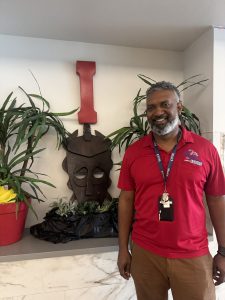
This year, an African mask Adlain created inspired by the Kikuyu people of Kenya during his time in college is displayed in the school’s front entrance.  

He brings his own cultural technique into his classroom, encouraging learning about the African mask-making traditions. Students learn to create their own masks while studying clay and ceramics, as well as both two-dimensional and three-dimensional drawing techniques.  

Students also explore their creativity through cultural art projects throughout the city, allowing them to contribute to the stories and identities reflected in their own communities.   

Inspired by his family of five, Adlain said he chose to become a teacher after the birth of his youngest child, hoping to support students in the same way he supports his own family, ensuring they feel safe, nurtured and encouraged to learn. 

“I chose to be a teacher,” he said. “My parents were teachers. I thought I was going to come to school and just teach, but I’ve been learning as much from the students as they have learned from me. The students are so creative and have so many hidden talents. Their perspectives are unique, and they bring such a variety of experiences to the table. I find myself sitting back and letting go and allowing them to take control of the art.” 


Thank your support staff  

Each year on April 3, we celebrate Paraprofessional Appreciation Day, a time to recognize the dedicated support staff who play a vital, yet sometimes unsung, role in student success and the environment at each campus. 

Paraprofessionals are the quiet force behind school success, community building, and daily campus operations. From school clerks, registrars, and data controllers to parent support specialists, custodians, office managers, and teacher assistants, each role plays a part in shaping campus culture.  

Parent support specialists serve as essential bridge builders and advocates, connecting families to resources, organizing workshops, and strengthening partnerships between schools and communities. From office managers that set the tone for a welcoming environment to custodians who maintain campuses with care and pride, each role makes a meaningful impact.  

Barbara Valdez, the parent support specialist at Clinton P. Russell Elementary School, has made a profound impact on the school community in just her first year.  

Every day since the first day of school, parents have stepped up to volunteer during arrival and in various roles throughout the day because of her efforts to coordinate and encourage parents. Beyond the campus, Valdez actively collaborates with community organizations to ensure students and families have the resources they need to thrive. 

“Ms. Valdez is truly an asset to our campus,” said Principal Chara Pace. “As we continue to maintain our A rating, the strong partnerships she is building will be vital to our continued success. We are grateful for her dedication, compassion, and commitment to our families.” 

On April 3, take the time to thank one of the thousands of paraprofessionals across Dallas ISD for showing up each day with ideas for school success, patience and an unwavering commitment to students.