Achieving success on a national stage
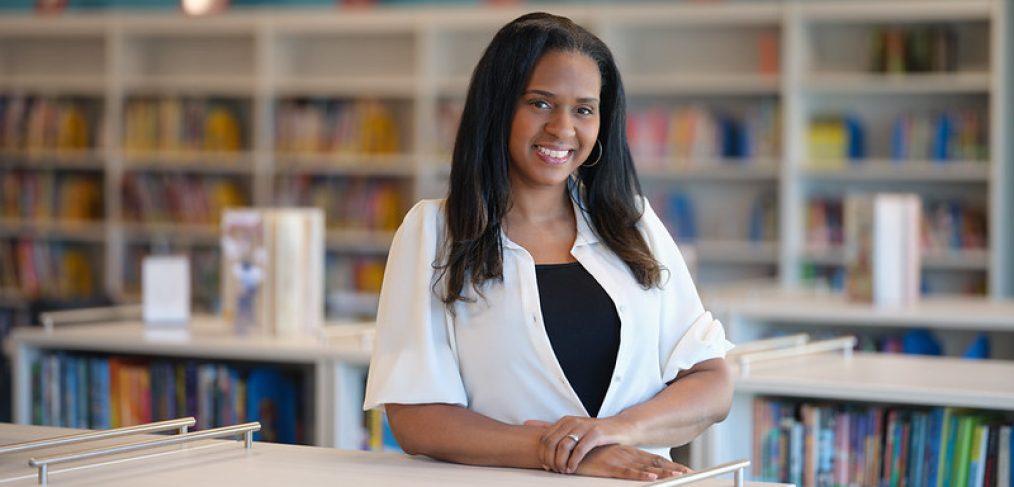
Late one evening, at Victor H. Hexter Elementary School, librarian Yasmeen Youngblood opened an email that would quietly place her on the national stage.
A longtime colleague, she said, had nominated her for the Scripps National Spelling Bee Educator of the Year Award, which recognizes school staff who go above and beyond to encourage a love of spelling. She is one of the finalists for the 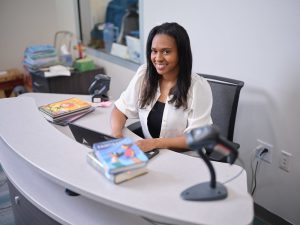 award.
“I didn’t know that the award existed at first,” she admitted. “We were both here late one night, and the email came through for both of us. And I was just like, ‘Oh, what is this?’”
At first, it seemed like a routine inquiry. The message simply asked whether she would be available for a Zoom interview the following Monday. Only after participating in that meeting did she realize the scope of the honor.
“The representative from Scripps called and asked if we could do another Zoom,” Youngblood recalled. “She told me then that I was one of the finalists. I was just in shock. I could not believe it. I went running down the hallway telling all my co-workers and my principal. It just feels unreal.”
Youngblood grew up in Michigan and did not start her career in Dallas ISD in 2007 expecting national recognition. She has spent nearly two decades at Hexter, primarily teaching fifth-grade English language arts and social studies before becoming the campus librarian.
Her first dream, however, was journalism. She studied communications and journalism at Grambling State University and even secured an internship with The Dallas Morning News. But when she prepared to move from Michigan to Texas, her parents urged her to find a full-time job rather than an internship. That push led her to an alternative certification program and into the classroom.
“I thought, ‘Okay, maybe I won’t be a writer, but I can teach my kids writing,’” she said. Over the years, that decision has been affirmed again and again.
“Just last spring, I had a student who’s now in college visit me and say, ‘The things that you taught me, the way you taught me to write in fifth grade, I carried those same skills into college. You’re the one who made me a writer,’” she said. “That definitely solidified that I made the right choice.”
Youngblood’s recognition from Scripps is closely tied to the spelling bee culture she has built at Hexter.
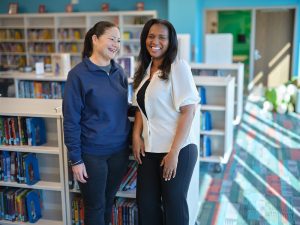 Her own connection to spelling bees goes back to her time in seventh grade, when she competed and placed in the top group, even though she did not win. Her English teacher made a banner honoring students who had done well.
“All year, that banner hung in her room, and it had my name on it,” she said. “It made me into a better student, just because people then expected that of me. I knew the power of being visible and of people seeing you as a high-achieving student.”
When she arrived at Hexter, the school’s spelling bee was a modest affair, held in a classroom with a handful of selected students.
“I asked the next year if I could take it over,” she said. She formed a committee, moved the event to the auditorium, invited parents and students from multiple grade levels, and opened participation to anyone who qualified.
“It just became this big event,” she said. “It became part of the culture at Hexter. Kids started aspiring to it.”
That visibility, she explained, changes how students see themselves and how others see them.
“I noticed that when they did well, they were treated differently by peers, because now they had done this great thing,” she said. “As their classroom teacher, I could see them trying harder in other areas as well.”
One former participant stands out in her memory: a “cool kid” who didn’t usually enter academic competitions and was also bilingual.
“He got in the spelling bee, and he was knocking out all the kids who were typically great students,” she said. “He’d walk up to the microphone all cool, spell the word, and go back to his seat like, ‘Yeah.’ You could just tell the crowd was like, ‘Wow.’”
His performance helped more bilingual students see themselves on that stage. For Youngblood, spelling is about more than memorization.
“Really, it’s all about patterns and word origin,” she said. “Whether a word has Greek, Latin, or French roots or whether it has long vowel sounds or short vowel sounds.”
While she credits the lower grades with teaching students to read, she has been a strong voice on her campus for keeping spelling instruction in every grade. She created her own spelling curriculum and advocated for it in campus meetings.
“Spelling is important,” she said. “The kids are really reliant now on spell check, because everything’s on Chromebooks. I was noticing a decline in their ability to spell for themselves.”
Her concern is not just about correct spelling; it’s about students’ ability to express ideas in writing.
“A lot of times what holds them back from even getting their ideas out is the fact that they can’t spell the words,” she said. “I want them to be writing. I want them to be confident in spelling so their ideas can get onto paper.”
When Dallas ISD launched an initiative to place a librarian in every school, Youngblood transitioned from the fifth-grade classroom into the library. Now, instead of teaching one grade, she teaches prekindergarten through sixth grade in what she calls a “teaching library.”
“The kids come to see me once a week, and I target specific skills,” she said. Youngblood also analyzes TEKS and assessment data, coordinates with classroom content, and builds lessons that support literacy across the campus. The new role, she said, has helped her better understand how students grow as readers over time.
“It’s really enlightening for me to see that progression, going from being able to decode to actually reading for comprehension,” she said.
Looking ahead, Youngblood hopes her legacy in Dallas ISD is about what students believe about themselves.
“I want them to know that they are capable,” she said. “It doesn’t matter your background. It doesn’t matter if you’ve been a good student up until now.”
For her, the spelling bee is one of those opportunities, a chance for students to be celebrated for courage, effort, and academic achievement in front of their peers and families.
“Confidence is everything,” she said. “At some point, that’s all you have — that inner voice saying you can do it. I want that inner voice to be strong.”
As she prepares to travel to Washington, D.C., for Bee Week as a Scripps National Teacher of the Year finalist, Youngblood is mindful that she is not going alone.
“I’ve worked with so many great teachers who have made so many sacrifices,” she said. “I’m really grateful to be recognized, because I feel like I’m representing them.”