
Building a legacy in STEM
March is Women’s History Month, which was established in 1987 to recognize women’s contributions to history, culture, and society and highlight their vital role in many areas, such as education.
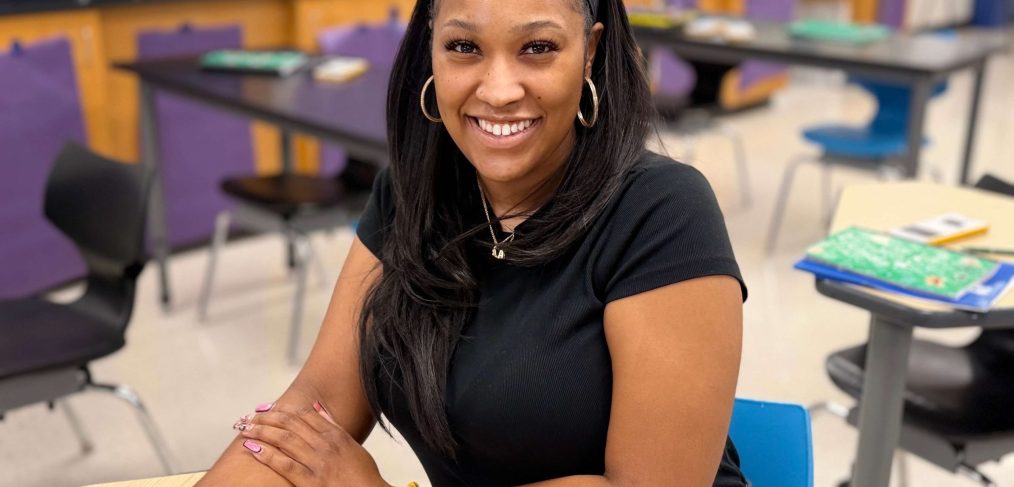
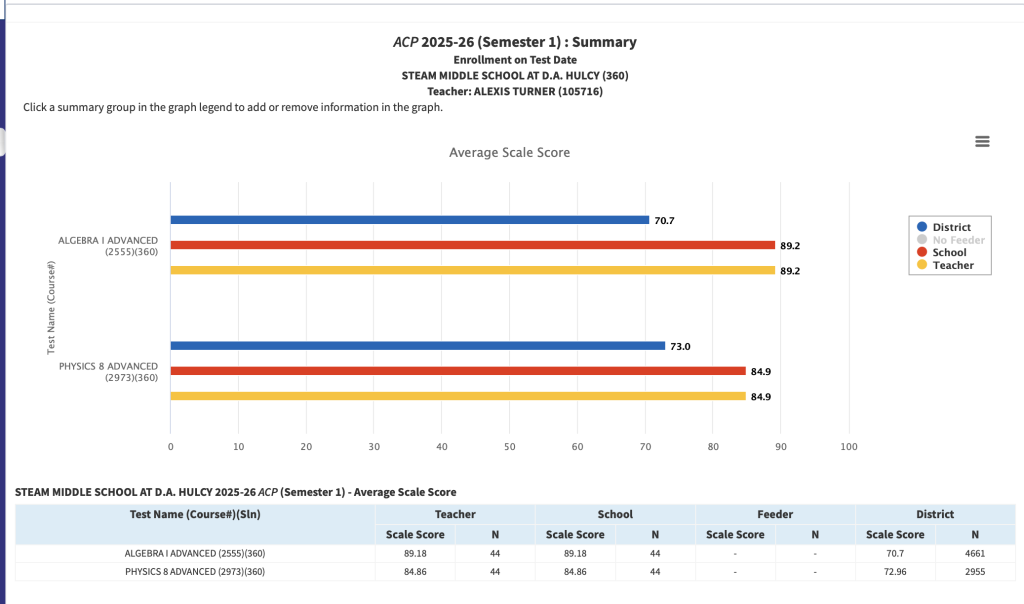
When Alexis Turner walks into her eighth-grade math and physics classroom at D.A. Hulcy STEAM Middle School, she is not just teaching content—she is rewriting what success looks like for students in a high-stakes academic subject. District data show her STAAR scores are consistently above the district average, making her one of the top math educators in the area.
What makes this especially meaningful is where her story began—the same hallways where she now teaches.
Turner attended Hulcy and later graduated from the School of Health Professions at Yvonne A. Ewell Townview Center. Returning as a teacher, she describes her role as one that carries both responsibility and pride.
“To kind of come back, it’s kind of a full circle moment for me,” she said. “And then come back and do as well as I’ve been doing so far, I think that’s amazing.”
Turner’s academic path is firmly rooted in STEM. She earned a bachelor of science degree in biology, followed by a master’s in higher education, and is now pursuing a doctorate in educational leadership, all from Dallas Baptist University.
Initially, she envisioned a future in healthcare but found herself drawn toward a different kind of impact.
“I realized there was something else I needed to do,” she explained. “I knew I loved education, and I wanted to bridge the gap between STEM and the classroom—somewhere I could really make a difference.”
 That bridge now runs straight through her eighth-grade math and physics classes, where students not only learn content, but also see how those skills connect to future careers in engineering, biology, and other STEM fields.
In fact, one of Turner’s defining practices is how she begins each year, not by racing into the most advanced standards, but by deliberately rebuilding the foundation.
“I treat all my students as if they’re starting at the base level,” she said. “As if they didn’t have a sixth- or seventh-grade teacher. We start at something as simple as ‘three times three,’ and I build them from there.”
This approach is less about repeating old material and more about ensuring that every student, regardless of gaps or summer learning loss, has something solid to stand on. Throughout the year she cycles back to key basics: multiplication facts, integer operations, and especially negative numbers.
“Every year my students struggle with negatives,” she noted. “Adding and subtracting negative numbers gets them every time, so I work on it constantly. Basic skills like that are what everything else is built on.”
To reinforce those foundations, Turner uses timed multiplication-chart races, warm-up problems, bonus questions, and game-based practice. Even as students work on advanced topics like quadratic functions and two-step equations, she continues to weave in foundational questions so those skills don’t fade.
Turner’s students are enrolled in ninth-grade courses as eighth graders, and they face the pressure of high-stakes STAAR exams. Still, the tone in her classroom is not fear—it’s clarity and challenge.
“The kids understand more than we think,” she said. “They know about the state standards. They know about the TEKS. So I lay it all out: ‘This week we’re working on these standards. This is what we have to hit.’ If you don’t show them, they don’t know what to look forward to.”
By making expectations explicit, Turner gives students a roadmap rather than just a stack of assignments. She pairs that rigor with flexibility around how students learn best.
“You have to give kids what they need,” she said. “If you need to stand up for a little bit, stand up. As long as you perform the work in front of you, I’m okay with that. I let them be who they are in my classroom, and I think that really helps.”
Collaboration is another constant. Most days, students work together, explain problems to one another, and “bounce off each other,” as Turner describes it. She’s intentional about how she groups them, matching strengths and needs like puzzle pieces.
To keep students engaged in content that can feel abstract or intimidating, Turner leans heavily on games and interactive activities—especially those that mirror the video game culture many of her students love.
“My kids love games,” she said. “So I turn lessons into a video game whenever I can.”
 For exponential functions, she created “Exponent Battleship,” where students use exponent rules to launch “attacks” on a coordinate grid—except their laptops function as the coordinate grids. She designs escape rooms that hide algebra problems inside riddles and locks. She also uses online games where students answer questions to “fight the dragon and escape.”
These activities serve serious purposes: repeated practice, real-time feedback, and peer tutoring. When one student gets an answer wrong, a partner helps them find the right answer. By the time they reach topics like quadratic equations and function analysis, they’ve practiced problem-solving through play, not just worksheets.
“I’ll tell them, ‘I want masters on every test,’” she said. “At first they look at me, like saying, ‘What are you talking about?’ But once they see the first test and realize it’s possible, everything changes.”
She closely monitors data, comparing class performance to district averages, and uses that information to build motivation and a sense of shared responsibility. Her students quickly become invested in not only their individual scores but their class’s overall standing.
“My kids get so invested that they’re upset if anyone is just in the ‘meets’ bucket. They’re really competitive, and that helps them push each other,” she said.
At the same time, she is realistic about the challenges students face, such as chronic absence or large skill gaps, and responds with targeted intervention. That can mean one-on-one or small-group support during class, or meeting students during lunch to reteach concepts.
“If you’re struggling, I’m going to focus on you until we get you where you need to be,” she said. “I tell them, ‘I’m going to get you there. You just have to let me.’”
Turner’s impact shows up in data, but it also shows up in how former students seek her out once they’re in high school. They come back to tell her they’re still using methods they learned in her class—and sometimes to admit they miss the way she taught.
She is especially mindful of her influence on girls in STEM, many of whom are navigating not just academics but the social pressures of middle school.
“I tell my girls, don’t stay stuck on what’s happening right now,” she said. “You have so much more ahead of you. Believe in what you’re doing and in the path you’re on.”
As we celebrate Women’s History Month, Turner’s hope is simple but profound.
“I want my kids to look back and say, ‘Ms. Turner was a great teacher. She helped me when I needed it, even when it wasn’t about math,’” she said. “No matter what their score was, I want them to know they worked to get where they are—and that they can always go farther.”