Turning challenges into success
As a young man, Roberto Garcia, Spanish teacher and wrestling coach at Thomas Jefferson High School, often got in trouble for fighting in school. Though he chalked it up to low impulse control, he now views it as an early foreshadowing of his passion for wrestling.
Garcia’s early years were marked by family, transitions, and challenges. In 2005, his family immigrated to Dallas in pursuit of better employment opportunities. His mother, who taught embroidery to low-income women, and his father, a government employee in Durango, Mexico, sought a new beginning. The crossing itself was arduous for his mother and brother, traversing the desert for over a week, but for Garcia, the journey was less treacherous.
“I got on a bus, fell asleep, and woke up here,” Garcia said. “Looking back, my journey was super easy. When my kids tell me about their own journeys—getting caught, staying in detention centers, and spending months traveling from Central America through Mexico to the United States. Mine was a walk in the park.”
Arriving in Dallas, Garcia cycled through several elementary schools as his family looked for work. Adjusting to a new language and culture, he struggled to communicate with teachers. Yet it was precisely this challenge that planted the first seeds of his academic ambition.
“I always felt, since the very first day of school in the United States, that it was my duty to represent Durango and represent my family and represent Mexico by doing the right thing here academically,” Garcia said.
 Middle school marked a turning point—Garcia discovered a calling in education and service. As he acquired a better handle on English, he began helping other newcomers in class, experiencing the joy and empowerment of breaking linguistic barriers.
“Once I started learning the language, I really enjoyed helping newcomers translate in my eighth-grade Algebra class,” Garcia said. “I loved being able to translate and seeing how excited they would get. I’d tell them, ‘Two or three years ago, I couldn’t even defend myself in English—but if you focus on the language, opportunities will come.’”
At Thomas Jefferson High School, Garcia found community and opportunity. Through the Patriot Ambassador program, started by Johno Oberly, a ninth-grade algebra teacher, Garcia and a cohort of students worked to improve school culture—tackling issues like teacher turnover, giving feedback to educators, and fostering pride.
“Mr. Oberly equipped us with the tools to identify issues within the school that we wanted to fix and then go about and fix them,” Garcia recalled. “And so he kept nurturing that interest in education, and most importantly, in leaving this school better for the next generation.”
Upon graduating from high school, navigating the American college system as an undocumented student, he faced financial aid inaccessibility, sparse opportunities, and, at home, the pain of his parents’ divorce. Thanks to the help of mentors and a benefactor who paid for his Deferred Action for Childhood Arrivals application, Garcia enrolled in the University of North Texas and eventually became the first in his family to graduate from a four-year university.
“I graduated college without taking out any loans; I paid for it all out of pocket,” Garcia said. “I wouldn’t have had it any other way, because the experience taught me the true value of money. It gave me a different perspective, and it’s why that degree means so much to me today.”
After stints in warehouse management and insurance, Garcia found his true calling back at Thomas Jefferson. In 2022, spurred by a Facebook post and his relentless desire to serve, he stepped into the classroom as an advanced Spanish teacher—and soon after, into the wrestling room as head coach.
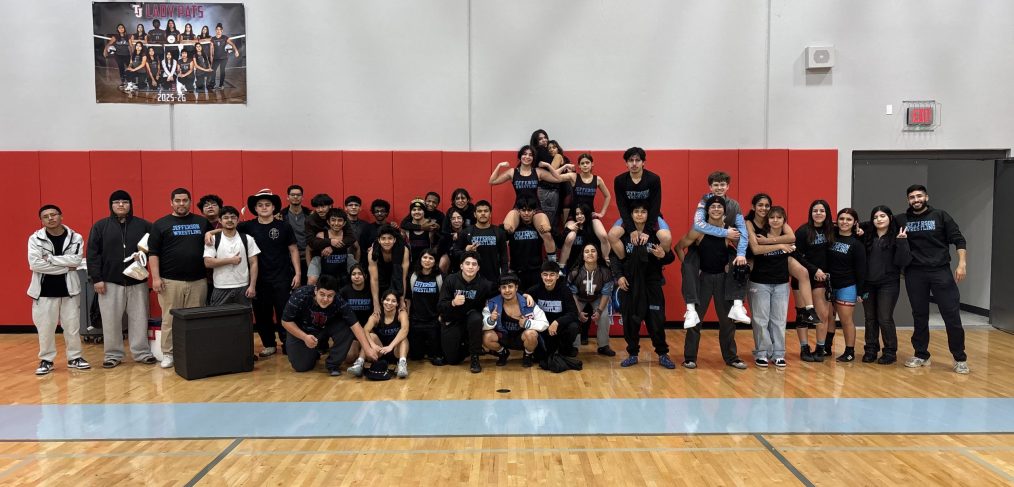
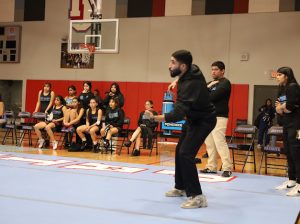
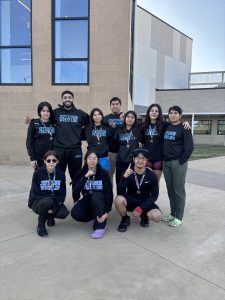 Despite no formal wrestling background, Garcia drew from years of boxing and fierce determination. He leaned on colleagues, friends from George’s MMA and Boxing Gym, and his own faith to build a program that quickly grew in size and stature. Garcia’s wrestling program now includes over 50 students, both male and female.
Garcia is especially proud of his female wrestlers, describing them as some of the toughest young athletes he’s ever met. Under his guidance, the program has grown to 27 girls, forming both junior varsity and varsity teams, and even producing the school’s first female college wrestler.
“I genuinely believe what attracts them most is the transformation they see in themselves—not just physically, but personally and mentally,” Garcia said. “If you have the discipline to maintain your weight, to make it through a season, and to wrestle while tired or hurt, you realize you can do anything in life.”
At the core of Garcia’s approach is authenticity. He believes in getting to know students as individuals, recognizing their challenges and supporting them holistically.
“There is no cookie-cutter system for teaching kids. It takes getting to know each individual—discovering what gets them going and what doesn’t,” he said.
His lessons mix structure and flexibility, encouraging autonomy, community, and hard work.
“I believe my philosophy is just engraved in the fact that hard work works, and that nothing is ever going to be given to us, and nobody’s coming to save us,” he remarked.
Garcia dreams of building not just wrestling champions, but resilient, compassionate leaders. He hopes to institutionalize wrestling throughout the community, open his own gym, and remain a pillar for Thomas Jefferson—all while inspiring students like himself to rise above their circumstances
“My ultimate goal is to provide opportunities for my students and give back to the community that has supported me,” Garcia said. “If I could have my kids remember me for one thing, it would just be that there is meaning in our suffering, and that if we want something in our life, we have to work for it. When things get tough, just get tougher.”