
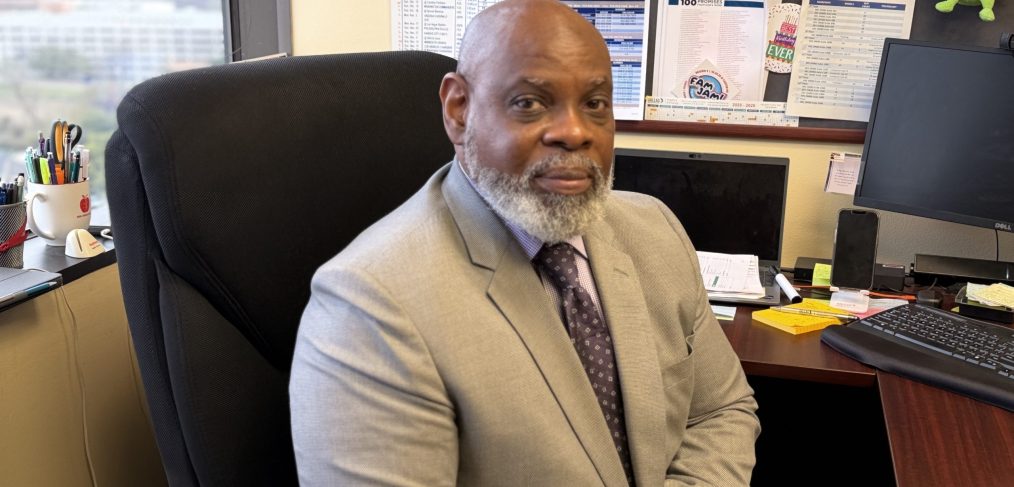
Connecting families
When you walk into a Dallas ISD Fam Jam event, what you see on the surface looks like a lively community fair: student performances, boxes of food, racks of uniforms, exhibitors offering resources, and families chatting.
But at its core, it is an event where families can access food, clothing, and shelter, which for Alrich Smith, manager of Family and Community Engagement, is essential because if families are worried about the basics, it’s unrealistic to expect them to focus on test scores and homework, he said.
“We want to make sure that every need, especially the basic needs that parents have or families have, are met,” Smith said. “Once those needs are met, then we can start working on the academic side of things.”
Smith’s own connection to the city is what helps him know what families may need. He grew up in Hamilton Park and later on Stults Road—neighborhoods he can see from his office window. Smith, who plays the drums at religious services and in a band, said his mother’s long career in the classroom shaped his own path to education.
“My mother was a teacher for about over 35 years,” he recalled. “That influence was always there. She always encouraged me to get my teacher certificate, which I did not, but the work that I did ultimately lended itself to me being hired as a community liaison at Barbara Jordan Elementary School back in 1999.”
Over the years, mentors taught Smith how to serve families, connect with schools, and build systems that last. His personal faith, he said, also guides how he navigates both “the best of days and days that are not so good.”
“I had a lot of good mentors, and I always considered myself a leader,” he said. “And so at some point, I wanted to be a part of leading this work and taking it to another level.”
Smith said that one of the biggest misunderstandings about the department is mistaking it for basic, surface-level communication.
“I always like to equate involvement and engagement,” he explained. “Involvement has more of a casual approach. I’m going to send you a flyer or make a phone call—that’s just surface-level involvement.”
True engagement, he said, is much more personal and intentional. “Engagement means I want to see you eye-to-eye and say, ‘Hey, I have something that you will benefit from,’” he said.
That distinction—from pushing out information to building relationships—is core to the department’s strategy, which aims to create what Smith calls fear of missing out.
“We want to create FOMO because we want parents to feel like, ‘Hey, if I don’t get this, if I don’t attend this, if I don’t participate in this event or activity, I’m missing out.’ So it’s up to us to be marketing majors,” Smith said.
The ultimate goal is that parents become active partners in their children’s learning.
“Our mission is to make sure that they have access to any and all resources, both internal and external, so that when it comes to academics, they can pour themselves into their child’s academic experience, and their child will be better for it,” he said.
Smith’s department, however, is best known for its flagship Fam Jam events: large-scale health and education fairs that bring together 60–70 exhibitors alongside student performances and on-site support.
“It’s like one big, giant opportunity for families to get everything that they need for that moment that they need,” he said. “We’ve had a pretty much 98 to 100 percent satisfaction rate on all of those events. So that’s a big part of where our success lies.”
Beyond Fam Jams, the team runs FROG (Family Resources on the Go), a mini-mobile Fam Jam that brings resources directly to campuses, Smith said.
“Families have opportunities to get linked in with the Parent Portal or get a free uniform. We have food, clothes, socks, and free educational resources—just for showing up and signing in,” he said.
According to Smith, some of the most impactful work happens in moments of crisis.
“When we’ve had emergencies—houses burn down, flood, or people lose their belongings—we were able to provide district families with not only uniforms, but also gift cards so they can get some of the basic necessities in life,” he noted.
On the academic side, Academic Partnering sessions and Facebook Live events (in both English and Spanish) connect parents directly with teachers to talk about grade-level expectations and learning strategies.
“We talk about how parents can be involved in their child’s academic experience,” Smith said. “We have teachers who come on and talk about grade-level specific things to help bridge the gap between teaching and learning, home and school.”
None of this happens, of course, without a dedicated team. The department operates as one office with two teams: a program support team that coordinates districtwide events and a campus support team of coaches who work with parent support specialists on individual campuses.
“Our campus support team goes to the campuses to empower, engage, and train parent support specialists so they can build their capacity to work with families directly,” he explained. “We have an incredible team—no, not incredible, but remarkable.”
Smith often tells his staff that an organization is only as strong as its people and its systems. In practice, that means they spend as much time building clear processes—how a school requests uniforms, how a need gets escalated, how events are promoted—as they do loading boxes into vans.
“If you’re empowering your people, giving them a depth of knowledge about the work that they do, understanding the ‘why’ of what we’re doing, and having clear systems in place, then that’s what I would say makes an organization strong,” he said.
This year’s motto is “next level,” a commitment, he said, that “everything we’ve done has been better than it was before last year.”
When Smith thinks about how he hopes others will remember his leadership, his answer echoed the mission of family engagement itself:
“I want people to say of me, ‘He empowered me to think bigger than I ever thought before,’” Smith said. ‘“He helped me understand the why behind our work.”’