Preparing generations of health workers
March is Women’s History Month, which was established in 1987 to recognize women’s contributions to history, culture, and society and highlight their vital role in many areas, such as education.
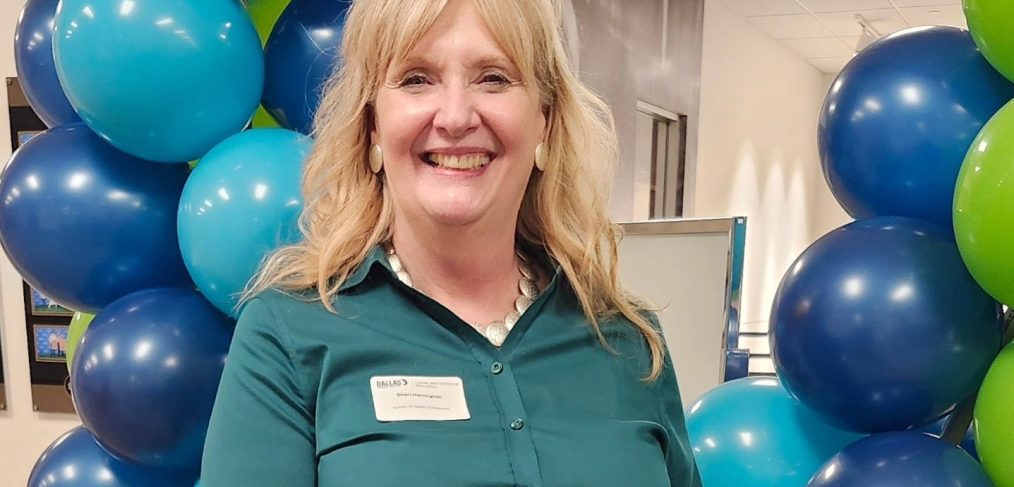
When cluster coordinator Shari Harrington started teaching at the School of Health Professions at Yvonne A. Ewell Townview Center in 1995, she was a young medical laboratory scientist stepping out of Parkland Hospital’s microbiology lab and into a high school classroom. Three decades later, she’s become the living memory of the School of Health Professions, a school whose influence stretches across Dallas-area hospitals, clinics, and dental offices.
The story, she explained, begins long before Townview Center existed.
“Our programs actually started in 1972 at Skyline High School, and we had a medical lab and a dental lab program,” Harrington recalled. “Then in 1977, because of the desegregation court order, the School for Health Professions was started.”
Those original programs—the medical lab and the dental lab—formed the backbone of a new specialized high school. In 1995, the school moved again, this time into the newly opened Townview Center. Harrington’s first year in the classroom was also Townview’s first year in operation.
“The original teacher that started in the health professions program in 1972 was Patricia Kidd,” Harrington said. “She became the coordinator in 1995 when Townview opened.”
In all this time, Harrington has carried forward the work of her predecessor: to prepare the health magnet’s students to thrive in healthcare.
Today, students who have completed foundational science courses in the ninth and 10th grades can choose from five two-year pathways in the school: clinical medical assisting, dental assisting, exercise science, medical laboratory, and patient care technician. Each pathway combines rigorous academics with hands-on practice and industry-recognized certifications.
In medical assisting, students learn to work the front desk and the exam room—scheduling appointments, taking patient histories, and recording vital signs. They can graduate with both a medical assisting certification and an insurance billing and coding certification, positioning them to work while they pursue college degrees.
“For a high school to be seeing real patients is very unique,” Harrison said. “The students are able to get that real life experience.”
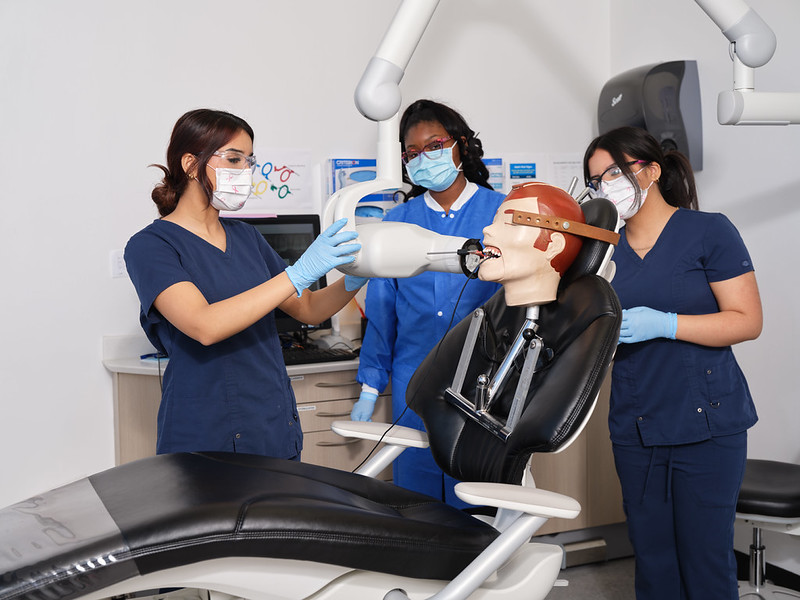
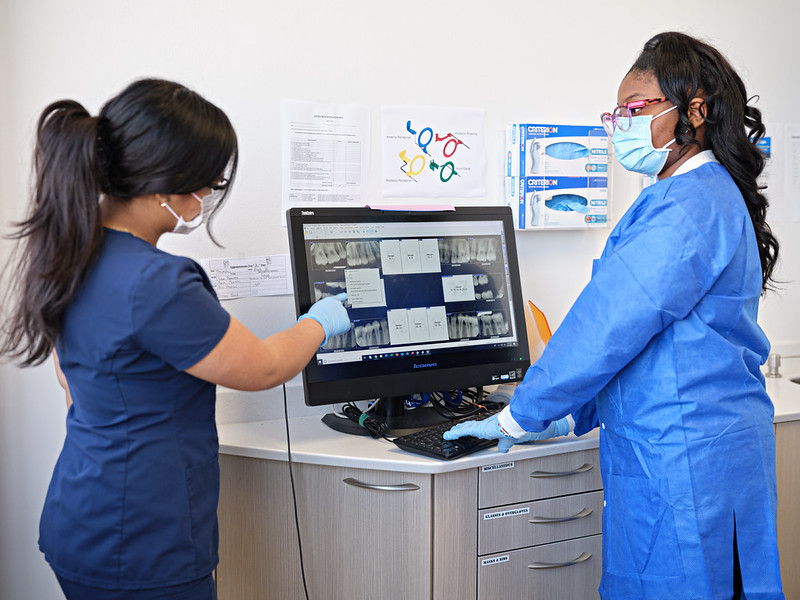
The program contracts with two dentists who come to campus one to two days a week from mid-October to mid-May. Working closely with nearby elementary and middle school nurses, the program identifies Dallas ISD students in the surrounding neighborhood who need dental care but might otherwise go without. Students also help schedule appointments, take X-rays, manage digital dental software through a partnership with dental supplies company Henry Schein, and assist chair-side during fillings, extractions, and cleanings.
“Henry Schein has provided us with access to clean clinical dental software so the students can learn to do all the administrative tasks that they would need to do in a dental office,” Harrison said. “The students even take X-rays on real patients, and we have a 100% pass rate for most.”
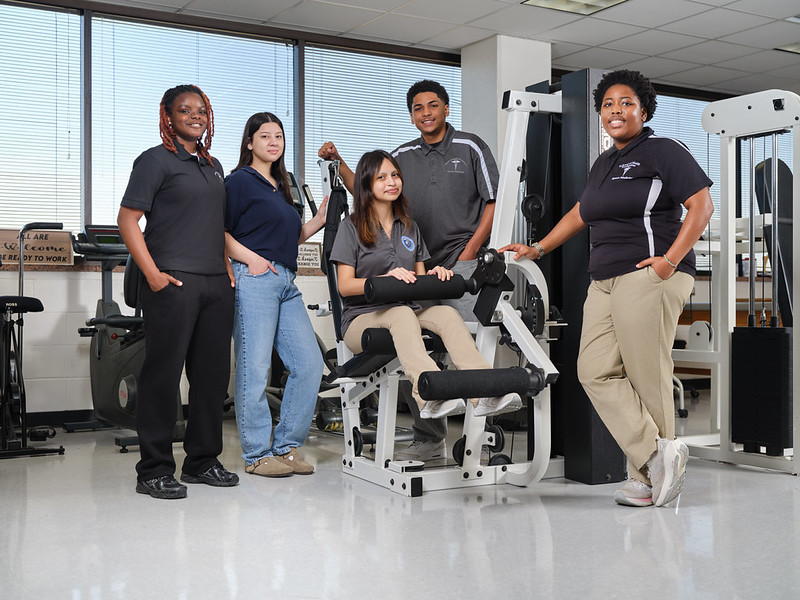
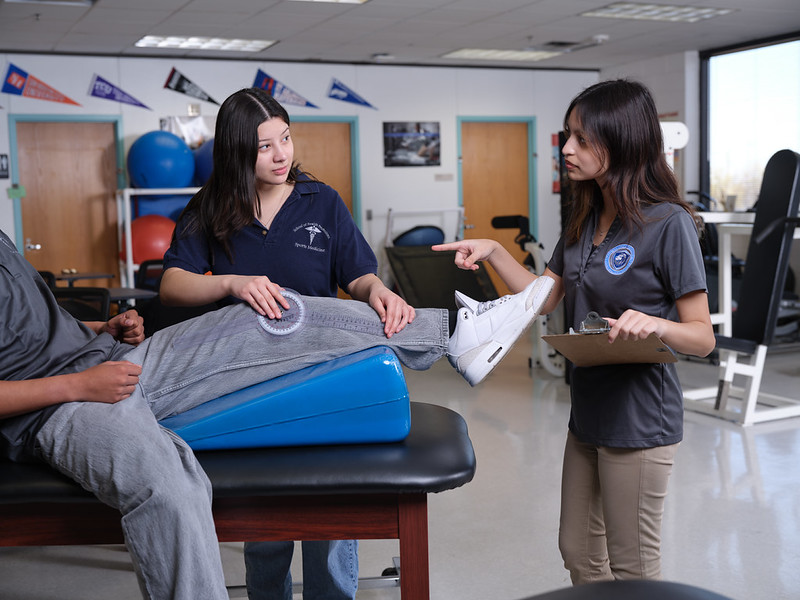
The exercise science pathway serves students interested in physical therapy, occupational therapy, speech therapy, and athletic training. Juniors intern at rehab facilities, hospitals, and nursing homes, and seniors return to their home campuses to work with Dallas ISD athletic trainers across sports seasons.
“For our exercise science, students do EKGs on live patients. They also practice all of those skills on each other, so they’ll be able to do it properly once they’re out in the real world,” Harrison said.
Dating to 1972, the medical laboratory pathway is the longest-running strand. Students learn to collect, process, and interpret samples, practicing both finger sticks and venipuncture and earning Phlebotomy Tech and Medical Laboratory Assistant certifications.
Harrington said that for students who want to be in healthcare but not necessarily hands-on with patients, this is the perfect option.
“Sometimes, if you’re interested in healthcare, but really not interested in working and touching patients, that’s a good one to do,” she said. “Because it is such a science-based, laboratory-based program, it’s going to help you with every science class you take in college.”
The patient care tech pathway is a dual credit track, limited to 32 students because of Dallas College requirements. Juniors work in nursing homes, while seniors gain experience in hospitals. Along the way, they earn dual credit, patient care tech, and phlebotomy certifications, and many graduate with a Dallas College certificate already in hand.
Pre-COVID-19, Harrington estimated that about 95% of students–-who qualified on grades, attendance, and behavior—were placed in internships.
“We’re probably back up to about 90% of students who are qualified to go to internships, and we’re hoping to return to that 95%,” she said.
Students have interned in such institutions as UT Southwestern, Methodist Dallas Medical Center, Scottish Rite for Children, as well as private physicians’ offices and research laboratories. Some end up working where they interned, and others return every summer to their internship placement until they graduate from college or professional school.
“There’s probably not a hospital or healthcare facility that you could go to in Dallas that doesn’t have at least one of our students working there,” Harrington said.
Over the years, many graduates have come full circle: one former dental student is now one of the program’s dentists. Others have become dental hygienists while several nurses and a nurse practitioner who graduated from Townview now visit as professionals. Some have even come back as teachers. And, increasingly, alumni are returning with their own children.
“Seeing a former student come in with their child applying to our school is rewarding,” Harrington said. “It’s starting to happen more frequently, and it’s always awesome to connect with that graduate and to know that their child is now interested in us, too.”
But for Harrington, the work is about more than certifications or even college readiness. For Harrington, the work is about the future, about shaping the people who will one day care for her, her colleagues, and the wider Dallas community.
“We’re educating our health care providers that are going to take care of us when we get old,” she said. “We’d better do a good job.”