It’s all about the water for science club students
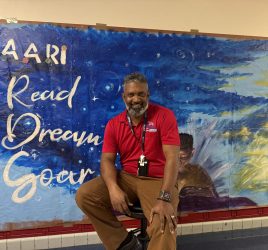
When chemistry teacher Bryan Arinaitwe looked at his students at Moisés E. Molina High School in southwest Dallas, he saw something too important to leave inside the classroom: untapped potential. Today, that potential is powering a student-led water quality research project that is giving teens a taste of college-level science—and a voice in conversations about the safety of their own school environment.
What began as an idea for a science club has grown into a grant-funded investigation of the drinking water at Molina High School. With support from the Dallas Education Foundation and the Dallas Environmental Education Initiative, students are systematically collecting and testing water samples from water fountains across campus.
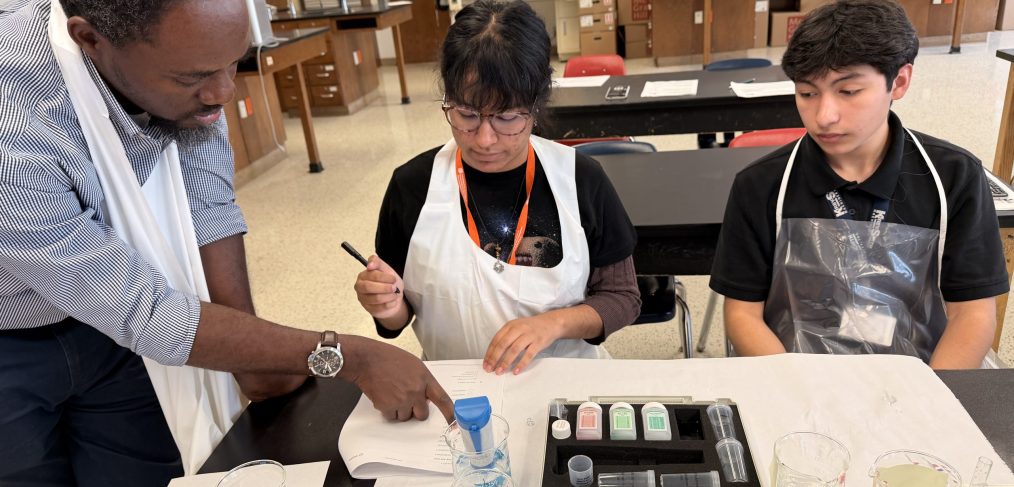
 “We’re analyzing the water we drink here to see if it is up to the standards that are required for safe drinking water. After that, we are going to write a report and present it to the school and to the district based on what we find,” explained Arinaitwe, who was born in Uganda and has published scientific research of his own.
The project doesn’t stop at Molina’s front doors. Many of the students come from high-density households in southeast and southwest Dallas, where seven to ten people may share a single home. That reality led the group to design a second study focused on indoor air quality in students’ own houses, with a plan to present those findings at a science fair in May.
The science club itself is brand new, formed this semester after Arinaitwe proposed it to the principal. The response from students was immediate.
“We didn’t have a science club in Molina,” he recalled. “So I went to the school principal, proposed a science club, and started inviting kids. We have about seven girls and five boys.”
The group draws from multiple grade levels—sophomores, juniors, and seniors—and will soon expand to include fifth graders at Mary McLeod Bethune Elementary School, where Molina students will train younger children to collect water samples. Arinaitwe described this as a vertical project, one that links elementary and high school students through shared scientific work.
“We thought we could also give the kids at Bethune an opportunity to experience what impactful research looks like,” he said.
But from the start, Arinaitwe’s motivation has been to push students beyond worksheets and tests.
“These students are exceptionally smart, but the unfortunate thing is that they stay in the classroom, without trying to use that brilliance to be impactful in a real way,” Arinaitwe said
So far, the club has collected more than 70 water samples, organized into pairs of first-draw and post-flush samples from fountains around the school. Students arrive as early as 7 a.m. to capture water that has been sitting in the pipes overnight, an important part of their research methodology.
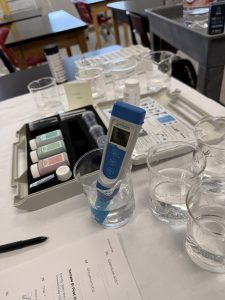 “They have to be here by 7 o’clock, because we have to use these water fountains before anyone else comes in,” Arinaitwe noted. “You see how committed the students are. It’s very rare to find kids doing that.”
Using test kits funded by grants and donations, the students are measuring pH; conductivity; water hardness; and dissolved metals such as lead, copper, and iron, and nitrates as indicators of fertilizer or sewage contamination. The results so far are mixed—but largely reassuring.
“What should be worrying is lead,” Arinaitwe said, “but there is zero lead. There is also zero copper, which means that the plumbing system is still good.”
Nitrate levels, which could indicate sewage leaks if elevated, are present but “significantly low.” The real surprise has been extremely high levels of magnesium and calcium, making the water very hard.
“The students have been checking the magnesium in the morning, and it’s high, indicating that this water is extremely hard. If you were to use it for laundry, you’d have to use a lot of soap,” he explained. “When you actually look at these water fountains, there is a lot of scaling because of the magnesium and calcium.”
While these minerals do not appear to pose a serious immediate health risk, they could, over time, damage pipes and fixtures, he said. Arinaitwe hopes to obtain more advanced equipment or lab testing to confirm the hardness levels before the final report is delivered.
Running two environmental research projects on a limited budget has not been easy. Even with grant funding, the club has run short on reagents and still lacks some equipment needed for the air quality study.
“Financially, we don’t have enough funds,” Arinaitwe said. “For the air quality work, we are missing some equipment.”
Despite the hurdles, he sees the investment as essential—because the project’s deepest impact is on the students themselves.
“This is a platform for students to experience college-level research,” he said. “Presenting to district officials gives them vital exposure and boosts their confidence. For many of our students, they simply haven’t had these opportunities.”
In a school of about 2,000 students, only around 12 are involved in this research. That scarcity creates opportunity.
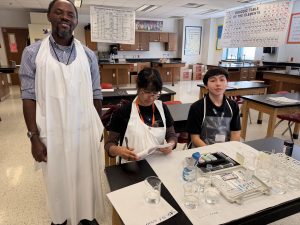 “This is a platform for them to earn scholarships,” Arinaitwe said. “By doing this, they are building their CVs and making themselves more competitive.”
The final water quality report, which the club aims to complete by April, will be shared with both the school and district officials. Arinaitwe believes the findings can help guide decisions on plumbing maintenance and verify the performance of local utilities.
“This study is also like a checker to see how much work Dallas utilities are doing to make sure that the water is kept safe,” he said. “And so far, we’ve found that they are doing a great job, because much of the water is actually clean, except for the high magnesium.”
But for Arinaitwe, the legacy of the project goes beyond infrastructure.
“In my house, I want my kids to be better than me, and in my class, I want my students to be better than me and better than who they are,” he said. “By turning water fountains into serious research, I hope to help these young people see themselves not just as students, but as scientists—and as advocates for the health and future of their community.”