
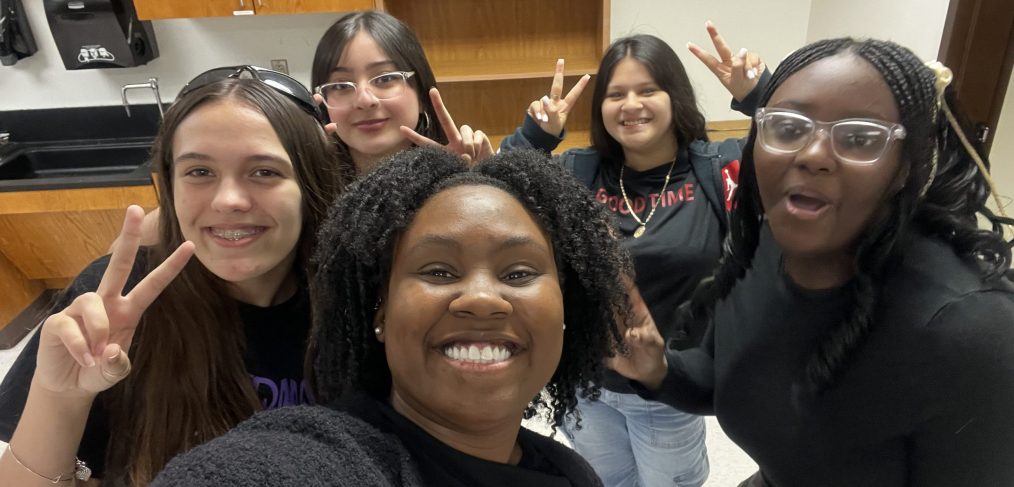
 Simone Chandler, a science teacher at Young Women’s STEAM Academy at Balch Springs and Dallas ISD graduate, credits her early exposure to science for shaping her career in education and her journey toward becoming a dentist. Now, she is preparing the next generation to be resilient and inquisitive girls.
International Day of Women and Girls in Science on Feb. 11 highlights the importance of encouraging young women to pursue innovation, discovery, and leadership in science, technology, engineering, and mathematics. The observance also recognizes learning environments, such as the STEAM academy, that promote equity and opportunity in science education.
Chandler has taught at the school for four years and understands firsthand what it means to grow up with a love for science. From her early years as a student at Harry Stone Montessori, to her high school experience at the School of Health Professions at Yvonne E. Ewell Townview Center, she was encouraged by educators who supported her plan to become both a dentist and a teacher.
She earned her bachelor’s degree in biomedical science from Sam Houston State University, and while teaching, Chandler is continuing her own goal of becoming a dentist.
“When I was in eighth grade in my science class, I knew I wanted to be a dentist,” she said. “Our teacher took us to the Texas A&M College of Dentistry downtown, and I knew that was what I wanted to do. It’s science and it’s art. I get to make people happy and bring them out of discomfort. It’s my ultimate STEM dream.”
Receiving her Registered Dental Assistant certificate while at Townview gave Chandler a head start after high school, allowing her to secure a position as a dental assistant at Mint Dentistry, where she worked for three years before becoming a teacher.
These days, between preparing for the dental school admission test and developing student lesson plans, Chandler is living by the values she teaches in her classroom—a growth mindset and an understanding that mistakes are not failures, but a necessary part of learning and scientific discovery.
“It’s fun being a teacher because you can show the girls different ways of thinking and different points of view,” Chandler said. “I am preparing them to be more confident in the science field and more confident in understanding the why behind how things work.”
Her philosophy as an educator is to make science relatable and to use the subject to prepare students to become critical and ethical thinkers in their everyday lives.
Chandler also leads the coding club at her campus. Through the Young Women’s Preparatory Network, a local nonprofit that supports young women in education, students participate in an annual STEAM Challenge.
Last year, Chandler guided her students in creating a prototype that addressed challenges related to natural disasters and the people affected by those incidents. After competing at NorthPark Center, students earned the People’s Choice Award.
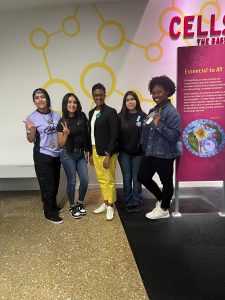 “I’ve taught here for most of my teaching career,” she said. “Teaching the girls here is what I’m used to, and I love it. I honestly don’t want to ever leave.”
Through her work in the classroom and beyond, Chandler is ensuring that more young women see science not as an obstacle, but as a pathway that prepares them to navigate life with confidence.
“Science is driven by curiosity, and your curiosity leads you to learn different things about the world,” she said. “Developing girls’ curiosity when it comes to science is my whole goal as a teacher, because STEM is the biggest force behind many things in our world.”
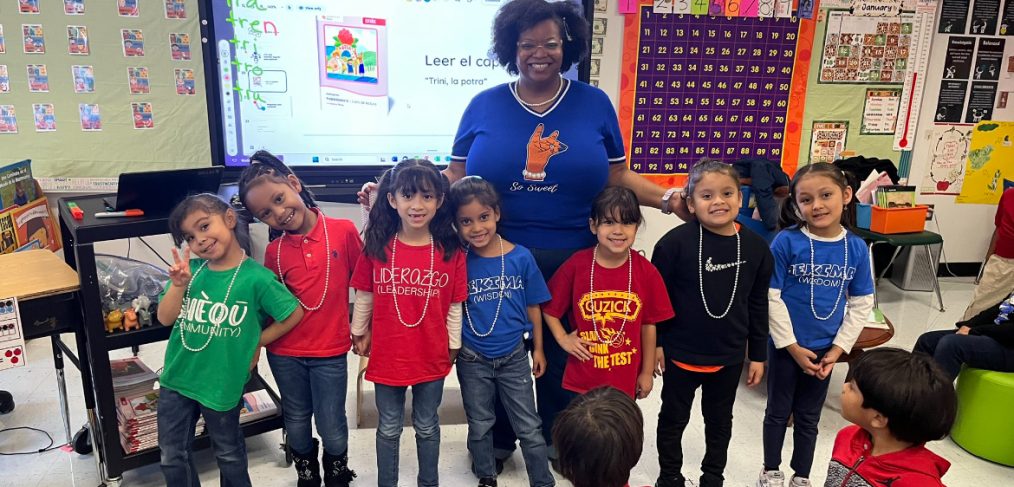
 During National School Counseling Week, Dallas ISD recognizes educators who support students’ academic success while nurturing their social emotional well-being. At Frank Guzick Elementary School, counselor Elizabeth Reed-Smith is creating a student-centered program that helps young learners understand their emotions and build confidence.
 One of the strategies Reed-Smith uses is a sensory activity called “calming bottles.” During the activity, students fill a plastic water bottle with clear glue and glitter. When they feel frustrated or upset, they shake the bottle and watch the glitter slowly settle at the bottom, practicing deep breathing until the glitter becomes still.