Math Magic prepares students for the future
One of the most important rites of passage in a young person’s life is the ability to do mental math without conscious effort. Children begin training for this process, known as automaticity, in the first grade and continue through elementary school. But as curriculum coordinators visit classrooms throughout the district, they’ve identified a recurring challenge: students lack the immediate recall of basic facts necessary for higher-level problem-solving, according to Aaron Daffern, director of mathematics in Academic Services.
“It used to be that there was this false dichotomy: you either memorize everything but don’t understand what it is, or you go to the other extreme and just explore, but you aren’t very fast,” he said. “Education tends to swing both ways, but there’s no reason why you can’t have both. Sometimes [exploration] comes at the cost of your facts; we want to be able to do both.”
To balance memorization with conceptual learning, Academic Services introduced Math Magic this past fall—an initiative designed to help students develop automaticity in basic addition, subtraction, and multiplication facts. Mastery of these facts frees up valuable cognitive resources, enabling students to engage with complex concepts instead of being bogged down by calculating basics.
“If all of my mental energy is spent trying to remember what eight plus seven is, there isn’t much space left to figure out whether I should even be adding or subtracting,” Daffern said. “We noticed there was an opportunity to increase that fluency through our walks this year.”
Implementing the magic
To tackle this, Math Magic provides a progression of standards-based benchmarks for first through third grades. First graders aim to master addition and subtraction facts up to a sum of 10, second graders within 20, and third graders turn to multiplication facts within 100—each step aligned to TEKS state standards.
Knowing that timed tests can sometimes feel daunting, the district designed Math Magic to be high-structure but low-stress. The program is built on a series of six milestones, following the natural progression of the curriculum—starting with easy zeros and ones before tackling the “boss levels” of sixes, sevens, and eights, Daffern said. To keep energy high, the program uses “gamified” incentives, including immediate feedback, candy, and a T-shirt prize once students have completed all six milestones.
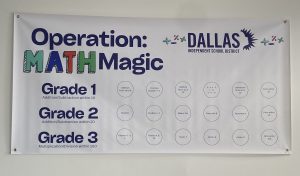 Banners at each campus track classroom accomplishments and create a sense of healthy, inclusive competition.
“Every school has received a progress banner featuring grades first through third with six milestone circles each,” Daffern said. “Once 80% of a grade level masters a specific skill—such as doubles in addition or zeros and ones in multiplication—the school covers that circle with a checkmark, thumbs up, or their school crest.”
Promising results
Initial feedback from schools, such as Richard Lagow Elementary School, has been promising, underscoring student excitement and ownership. As Daffern noted, “Kids were so excited. They were competing against each other, and they were monitoring their own progress—‘I missed eight last time, but I only missed four this time.’”
Beyond the classroom, one of the most heartening results of Math Magic has been parent engagement. While modern math strategies can sometimes feel “new” or confusing to parents, a math fact sheet is a universal language. These practice sheets—available as Google Docs—can be sent home, empowering parents regardless of their own math confidence.
“One suggestion we give teachers is to send these Google Docs sheets home. As a parent, I might struggle to help with third-grade math if it’s been a while since I was in school, but I know how to use a practice sheet to help my child memorize facts,” Daffern said. “We wanted to provide a resource that parents can access without needing to teach—they can simply use a timer, quiz their child with flashcards, and provide support at home.”
Teachers have been given not only the tools but also the latitude to fit the initiative into their unique classroom cultures. Most teachers recall timed tests as a familiar format, making Math Magic an “extra resource” that fits seamlessly into daily routines.
“Our goal was to make this as self-explanatory as possible. While new curricula like Eureka or Carnegie require extensive training, these are essentially timed tests—a format most teachers are already comfortable with,” Daffern said.
Teachers sharpen their tools
While students focus on Math Magic, teachers are also sharpening their own tools through the Math Teacher Collaborative. The Math Teacher Collaborative brings educators together to build their content knowledge and instructional practices, ensuring that teachers feel confident teaching both the basics and advanced math concepts.
“Last year, we launched a three-day training for 40 high-priority campuses to deepen teachers’ understanding of math content,” Daffern said. “Since many elementary teachers may specialize in reading or are new to math, we focused on the full progression of skills. We had kindergarten teachers work through fifth-grade math, and fifth-grade teachers explore kindergarten concepts, ensuring everyone understands how the curriculum builds and where their students are headed.”
While the impact will be measured anecdotally this year—tracking T-shirt requests and drawing on teacher and principal feedback—the hope is that the combination of structure, fun, and clear goals will ensure fewer students “fall through the cracks.”
“Students have struggled with this for a while. It’s very much like reading; if a student is reading on a third-grade level in high school, they can’t access those texts and won’t be able to do any of their coursework in high school English,” Daffern said. “Rather than trying to fix these gaps in middle or high school, we are placing the emphasis where it belongs: in first, second, and third grade.”
While the immediate goal is better scores on standardized tests like the STAAR, the long-term vision is about confidence. By the time these students reach middle school and are allowed to use calculators, they will have the foundational “number sense” to know if a calculator’s answer even makes sense.
“Kids enjoy this because they like being able to test themselves. It provides immediate feedback, and that opportunity for incremental growth is what really helps. You don’t actually have to motivate kids that much—they naturally like learning, and Math Magic provides it in bite-sized pieces,” Daffern said.