
Fleet Services is ready for winter and beyond
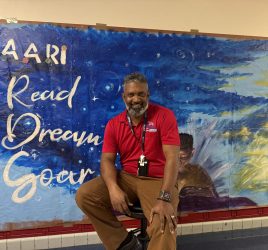
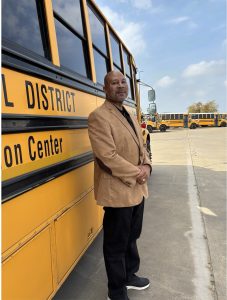
For most people, a drop in temperature means grabbing a coat. For Duran Hargest, director of Fleet Services, it also means mobilizing a team of 56 technicians to ensure that over 1,000 vehicles—including nearly 900 school buses and a new fleet of 17 electric buses—are ready to hit the road.
Electric buses
This is the first year the district will experience winter with electric buses, Hargest said. While Texas isn’t known for extreme cold, the unpredictability of the weather means the department must prepare for anything from icy roads to power outages. Hargest noted that while temperatures rarely drop below freezing for extended periods, cold snaps can reduce EV battery range by 5-15%.
“Cold weather can affect our EV buses, particularly with battery performance and heating demands,” Hargest explained. “At 32 degrees, I expect our EV buses to lose about 5 to 15% of battery power.”
To mitigate battery loss and keep buses on the road, Dallas ISD employs battery thermal management systems.
“Our buses are equipped with a battery thermal management system, which runs coolant through the battery cells to keep them cool in the summer, and that same coolant is used to warm the batteries up during the winter,” Hargest said. “It’s a big help when the real freezing weather arrives.”
When temperatures dip into the sub-zero ranges, Fleet Services adapt routes or substitute diesel buses as necessary, according to Hargest.
Summer mode vs. winter mode
For the hundreds of diesel and gasoline buses, however, the preparation is less about software and more about chemistry. Every fall, Fleet Services switches to “winter gasoline,” which is designed to ignite more easily for cold starts. Yet even traditional diesel and gasoline fleets demand preparation to be ready for winter.
“All refineries switch from summer to winter fuel,” Hargest explained. “Winter gas helps with cold starts and resists gelling.”
The department works with vendors to ensure on-site fuel tanks and buses receive anti-gel and water-treatment additives, keeping engines running through all weather conditions.
Hargest pointed out that most people don’t realize school buses don’t have a simple thermostat like a car, which allows them to regulate temperatures in no time at all.
“Every Thanksgiving break, we take our school buses and change them from ‘summer mode’ to ‘winter mode,’” Hargest said. “We actually have to go underneath the hood and turn valves to disable the AC system and enable the heaters. It only does one or the other—we can’t switch from heat to AC at any moment. When spring break rolls around, we switch them all back.”
Mobilizing the team
Winter fuel is only one part of the equation. When an ice storm looms, Hargest is the first to watch the radar. Even if the district is closed to students, his fleet technicians are classified as essential personnel.
“I’ll meet with my team or send a text: ‘The district might be closed, but I need personnel to come in.’ We go to the service centers to de-ice driveways, put out salt for traction, and ensure the centers are ready for when schools open back up,” Hargest said. “On mornings with lighter frost, technicians arrive an hour early to jump-start any buses that might struggle in the freezing air.”
Maintenance is a team effort, and every 5,000 miles, every bus undergoes a comprehensive preventive check—fluids, brakes, lights, even first aid kits. Yet the key behind this team effort is the partnership between drivers and mechanics.
“Drivers rely on us to keep the buses ready, but we also rely on them to report any issues—like low tire pressure—before routes begin. It’s a team effort,” Hargest pointed out.
The challenge of infrastructure
Hargest, a graduate of Booker T. Washington High School for the Performing and Visual Arts and an Army veteran with 26 years of mechanical experience, is a fan of the new EV technology—mostly because of the low maintenance.
“No oil, no fuel to worry about; I just have to put tires and brakes on it,” he said. Yet he is still realistic about the hurdles, especially as they pertain to infrastructure.
While some service centers are fully “future-proofed” with enough high-capacity chargers, others require ground-up electrical upgrades. Expansion is methodical, and each step is evaluated by contractors to ensure the district can meet current and future charging needs.
The transition to electric is still in its early stages. The drivers are learning the buses, and the buses are learning the drivers, Hargest said. Regenerative braking, route planning, and cold weather driving all affect range and reliability. Extensive staff training and clear communication protocols are integral to adapting to these changes.
A mission for the whole district
Dallas ISD’s fleet operation goes beyond just transporting students. Whether it’s repairing a police cruiser’s flat tire or switching a bus to “winter mode,” Hargest sees his department as the backbone of the district.
“My team supports the whole district—from HVAC and maintenance to IT and the police department,” Hargest said. “We’re a fairly new department, only a few years old, but our aim is exceptional customer service for everyone.”