
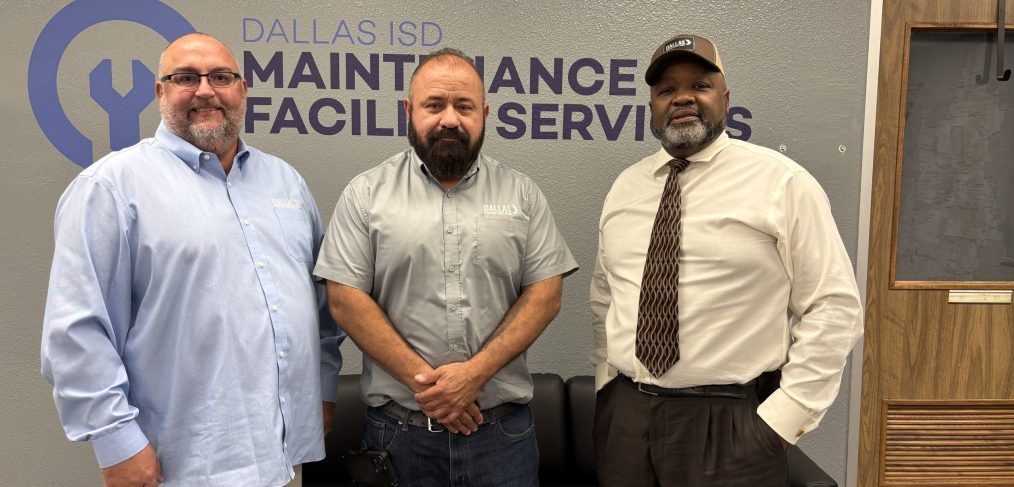
Maintenance team members are at the ready
While staff and students are off on winter break, it is often easy to overlook the critical team of 110 licensed technicians who keep roughly 300 Dallas ISD buildings running behind the scenes. With Texas temperatures capable of soaring to spring-time warmth or dipping to freezing, leaders from the Mechanical, Electrical, and Plumbing Department maintain 24/7 preparations and rapid response strategies to safeguard district buildings against cold weather, power outages, and potential storm damage—sometimes at the expense of their own holiday gatherings.
Preparation begins long before the first cold snap, usually in November. The boiler team, under the leadership of Project Manager Miguel Soto, performs preventive maintenance—including servicing boilers and inspecting HVAC systems—during milder months to ensure systems are functioning properly.
“We start firing boilers up, checking systems regularly, communications between systems and other routinary tasks,” explained Soto.
Beyond the initial maintenance, the MEP teams closely watch weather forecasts and scale teams as severe weather approaches. Rather than risking crew travel on icy roads, essential personnel from all departments—electrical, HVAC, and plumbing—are brought in and housed at the Cotton Building. For a major event, the HVAC department alone may increase its available personnel from 10 to 40 people.
“If we know that extreme weather is approaching, we keep staff here 24/7,” Soto said. “That is the whole goal: we must start before the storm gets here, because otherwise we won’t be able to get people back out on the roads.”
To assist these deployed teams, the Energy Management Center is a critical part of the district’s facility operations—especially during winter preparedness. It serves as a centralized “call center” that continuously monitors the status of HVAC systems, boilers, and other essential equipment across all district buildings.
Using both technology and boots on the ground, when freezing conditions threaten, teams are deployed in rotating shifts, covering four quadrants of the district. “We usually try to get a crew that’s going to be there depending on the weather to make sure nothing ices over,” said Director of EMP Barton Webster.Local knowledge is also essential. Even the custodial staff becomes indispensable on winter breaks, as they are tasked with checking their assigned school buildings daily for potential issues.
Power outages: The biggest threat
Despite all the preparations, the possibility of power outages in extreme temperatures remains one of the greatest challenges for MEP. According to Electrical Supervisor George Lakes, once temperatures drop severely—below 20 degrees–-widespread power loss is a high

risk. Since the heating and cooling systems depend on pumps to circulate water through pipes and coils to keep them from freezing, a complete power loss eliminates freeze protection often making bursting pipes unavoidable.
“Once you lose power, all bets are off. When you have power, you can control the situation better,” Lakes said. “We communicate with ONCOR to get power restored as soon as possible.”
The danger of power outages also means that high-value equipment can be lost instantly, as it happened during 2021 winter storm that resulted in a monetary loss greater than that caused by local tornadoes.
“Each chiller costs roughly half a million dollars to replace, and we lost 11 when the power went out,” said. “When the pumps quit, the water stops circulating. The standing water on the exposed coils—many of which are on the roof—will freeze quickly when the wind blows, causing damage.”
The electrical team also faces challenges related to moisture and infrastructure vulnerability. Extreme cold combined with precipitation can cause moisture and ice to accumulate on high-voltage lines and tree limbs, leading to downed lines and widespread power disruption.
“If there is any kind of moisture, it will accumulate on tree limbs, weighing them down,” Lakes explained. “When the limbs fall, they impact the high lines, and the high lines themselves will accumulate ice.”
On occasions when water enters school buildings, the situation is compounded by older facility designs where critical electrical components are housed at the base of the school.
“Back in the day, schools were designed with electricity on the bottom floor. That was wonderful—until water gets in there,” said Lakes. “When water hits those components, it stops the power. Our job is to try to get that water out and get the electricity back on.”
Plumbing and team coordination
Plumbing crews are proactive year-round, but during extreme freezes, they spring into action to isolate and drain vulnerable water lines in portables and unheated areas, quickly neutralizing the threat of burst pipes.
The plumbing team spreads its small number of technicians (just five people per quad, responsible for up to 75 facilities each) across four geographic quadrants. This is designed so that every campus has a technician familiar with the building who can immediately locate the water shut-off valves. This ability to instantly isolate a break is the single most effective way to limit damage.
“We’re in a rotation all night long in case there’s a pipe burst or anything,” Project Manager of Plumbing Bart Braswell explained. “If something bursts, we send out crews immediately to try to isolate whatever is damaged in order to prevent more damage.”
The preventive approach is not limited to cold responses. Crews meet with gas suppliers to make sure that heating systems supporting plumbing stay operational districtwide.
“We meet with Atmos Energy to ensure we are running our boilers at an efficient rate. We do this because there is a high demand for gas during that time,” Braswell said.
No incident is too large or complex for the department. The team recalled working through large-scale emergencies, such as a time when a city water main broke near Woodrow Wilson High School. This single incident affected four separate schools—Woodrow Wilson, Mount Auburn STEAM Academy, J.L. Long Middle School, and William Lipscomb Elementary School—leaving them all without water.
“The plumbing crew staffed it until the city got it fixed,” said Braswell.
When an incident occurs, digital boards in the Cotton Building track every reported issue across the district, categorizing it as “responded to,” “isolated,” or “completed.” Supervisors from all departments are in constant communication, prioritizing failures like offline boilers and major breaks.
“It’s an overall team effort to make sure that we’re responding and getting there at a reasonable time, so that there is not as much damage,” Webster said.
A commitment to continuity
For these technicians, holidays simply don’t mean a pause. The team’s commitment is driven by an understanding that their hard work keeps schools open, learning uninterrupted, and thousands of children and teachers safe each winter.
“If it’s Christmas Day and it’s extremely cold, we have people working here,” Soto said.
The constant efforts of the Mechanical, Electrical, and Plumbing Department and their commitment to keep buildings running year-around is what makes learning possible.
“Don’t take the air, water or temperature for granted. It takes a lot of effort to get there,” Webster said.